My second stranded colorwork knit: “Into the Wild”
Knitting the Bowfell jumper really got me into knitting stranded colorwork. As soon as I was finished with the yoke, I was just obsessed with starting a new project! Here it is : “Into the Wild” by Tania Barley.


My tips to start knitting stranded colorwork
This is only my second stranded colorwork project so I am an absolute novice – therefore in the perfect position to know what problems other novices may face!
- Find a good reference book to help you – mine was « Tricoter le jacquard en rond » by Anna Dervout, sadly only available in French.
- Take plenty of time to chose your colours.
- Start with a pattern that only alternates two colours on the same row. “Into the Wild” alternates three, so I would not advise it for a first project. But Bowfell (only available in Anna’s book) and Marieke (available on her web site and on Ravelry) work.
- Control your tension constantly. This is by far the biggest challenge of stranded colorwork; and I am definitely not there yet…
- Get yourself a yarn guide – I just cannot recommend this little piece of kit enough!

Knitting Into the Wild: pattern review
I had a lot of fun knitting this jumper: the pattern is very straightforward and well written; and the chart is not that complex to follow. The only challenge for me was to integrate a third yarn in the equation, but I managed it very well with my yarn guide.
Size-wise, I went for the smallest available but it wasn’t my best idea. I wanted a tight fit and the body is exactly how I like it but the neckband is too small – of well… Next time I’ll use the same size but will make sure to cast-on more stitches for the neckband.

Yarn choice
After Bowfell, which has abstract patterns, I was quite keen to have a go with a fun motif; and the little foxes of the “Into the Wild”jumper clearly had my name on them. Here is the (gorgeous) pattern presentation picture.

That said, I was not keen at all on the colours used – green and orange are my hate pets; and in general, earthy tones are persona non grata in my wardrobe, thank you very much!!
So I thought and thought and … well, I just went for my usual knit colour palette: pink, purple, burgundy, does it remind you of something?
It means that my foxes look more like little devils but I’m happy with that – better than knitting a jumper I would never wear!

Yarn-wise, I used:
- 7 balls of Drops Merino Extra Fine / Dark Heather (35)
- 1 ball of Drops Merino Extra Fine / Heather (34)
- 2 ball of Drops Merino Extra Fine / Powder Pink (40)

It was quite a change from my usual Drops Baby Merino/ Drops Kid Silk double-stranded combination… and much easier to handle for colorwork!! That said, the fluffy nature of Kid Silk makes it much more forgiving, so I feel all my mistakes are much more obvious without it.
Conclusion
This jumper is in no way perfect but it is a great object of pride, as it is my first attempt at “drawing with my needles” as I see it. More will probably follow, although I currently have a third stranded colorwork project on my needles currently and I am running out of steam. So my next project is more likely to be lace..
Sewing the V8379 dress…again!
When a dress pattern works, I tend to sew it again and again. So given the success of my first V8379 a few months ago, a second version was due to follow soon – here it is!

In no way dissimilar to its predecessor (except for the quality of the pictures maybe, oh well)…
V8379 pattern review – repeat!
I extensively reviewed this pattern in this article and nothing has changed, so just a quick summary of what I said before:
- This is a very quick and easy dress to make: it has a very limited number of pattern pieces; there is absolutely no technical difficulty (such as a zip or buttons); and the fit is very forgiving, as the pattern is designed for knits.
- What I love about this dress: its gorgeous pleated bodice, which works really well for my E cup without FBA; its beautiful fit-and-flare shape, with its knee-length semi-circle skirt; its perfect fit; and it lovely details (pleated bodice and sleeve bands).
- My only deviation from the original pattern was to put some iron-on interfacing around the side-opening for the belt, to strengthen it.

Fabric used: stretch but with weight
For both dresses I used Ponte Roma fabric , which has some stretch (as recommended by the pattern) but is also heavy enough to hold its shape. It is absolutely perfect for this pattern and I strongly recommend it. I would definitely not try making this dress is a very stretchy and light fabric.
A word of warning on Ponte Roma: always go for the viscose version, not the polyester one! The later piles when washed and your dress lovingly hand-sewn dress looks like a cheap rag in not time. I’ve been here before and had to throw away three dresses – heart-breaking!
Silly mistake!
Overconfidence is never a good thing when sewing, but it’s quite common when you reuse a pattern – for me anyway! So can you spot the silly mistake I made in my second dress?
It’s (thankfully) not that obvious but I initially completely forgot to stitch the bodice pleats in place. This stitching is not visible but it holds everything in place and without it… well, it just does not work! So I had to sew everything by hand and I am praying every time I wear this dress that the hand-stitching will not unravel!
Conclusion
Despite the not-so-perfect pleats, I’m very happy with this new addition to my wardrobe. Even more so because it perfectly matches one of my latest hand-knitted Hetty cardigans. I have one question though: how do your wear a cardi with a wrap dress? – I still haven’t quite figured out…
Sewing the Magnolia dress: more silk and more flowers in my wardrobe
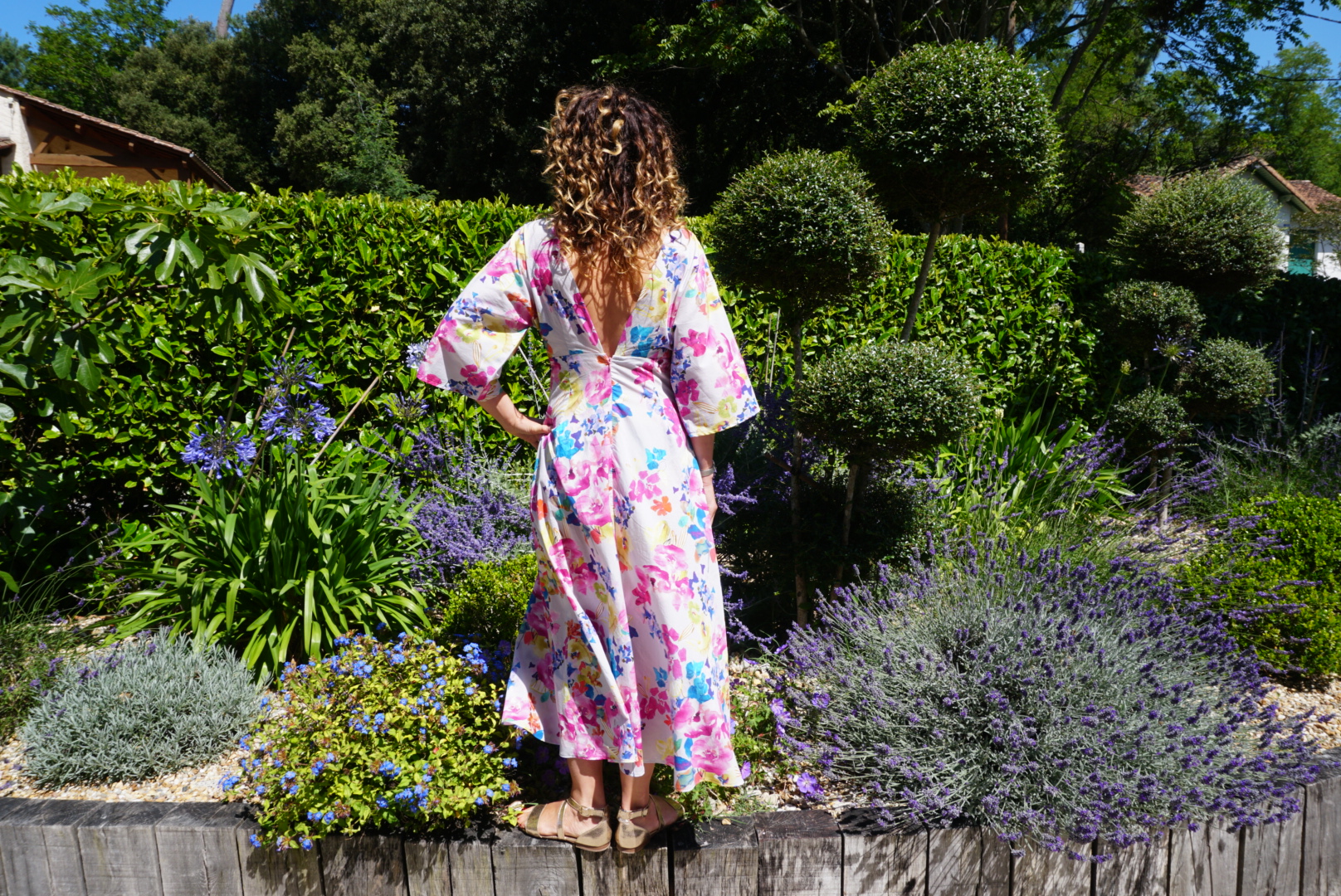
Although knitting has dominated the blog lately, I have in no way given up sewing. Here is my latest Magnolia dress by Deer&Doe, in a dreamy floral silk fabric from Selvedge and Bolts.


Magnolia pattern review: a long love story
Magnolia is one of my favourite dress patterns; and this version is the latest of a long series. In the past, I have sewn Magnolia dresses in stretch velvet (three times!); in none-stretch velvet; in silk to use as a luxury nightdress or a day dress. So many options!
There are many things I like about Magnolia:
- The shape is ultra-flattering. I am not a huge fan of empire waists but here it is just sitting at the right level. The multi-panel skirt perfectly balances the generous sleeves. And who does not love a wrap bodice?
- The bust fit (well, the entire fit actually) is perfect. Deer & Doe tends to size generously at the bust level. This suits me perfectly as despite my E-cup I never had to make any FBA for Magnolia (and neither for my Luzerne trench coat actually).
- This is an easy and (reasonably) quick project. There is no major technical difficulty with this project except for the invisible zip. And the dress comes together incredibly easily for such a stunning result. This is very comparable to sewing V9253, another of my favourite dress patterns.

- The pattern instructions are super clear, as always with Deer & Doe.
Sewing Magnolia more efficiently: my advice
I have sewn Magnolia so many times that there are a few things I do differently to what the instructions recommend.
To get perfect princess bust seams, I reduce my seam allowance from 1.5 to 1cm at this level before sewing pattern pieces 1 and 3 together; and I use an ironing ham to get the seams in shapes. I also reduce seam allowances before setting-in the sleeves, as I have noticed working with less fabric makes the process much easier.

For a neater neckline, I entirely line the bodice instead of using bias binding. This prevents any visible stitching right at the middle front of the dress. To do this, I simply make two bodices (one main fabric, one lining); attach them together at the neckline; clip the curves; and understitch so that the lining remains invisible. (Then I attach the bodice to the skirt and the the sleeves as if main fabric and lining were one.)
For a neater waist, I also line the belt. I make two belts (main fabric + lining) instead of one and sandwich my bodice between the top of the two belt. I attach the skirt to my bottom of the MF belt, fold and iron the seam allowance of my L belt and finish by hand.
And for a skirt with less panels, which is useful when you work with fabric with large patterns of just when you want to make the process quicker, I either use the V9253 skirt or simply two rectangles of fabric gathered at the waist.

Sewing silk: my advice
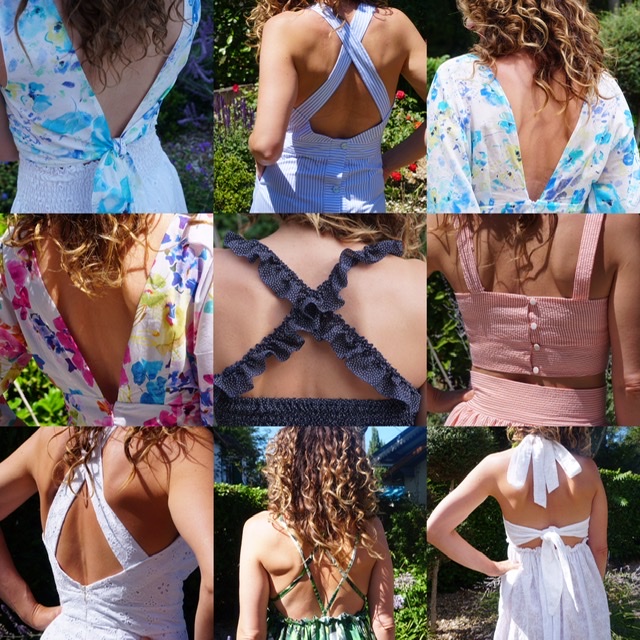
I am a horrible fabric snob and I adore wearing silk (cotton, wool, cashmere – natural materials only please!). I used to be terrified at the idea of sewing such a delicate material but after a number of skirt and dresses, not any more!! Over the past 18 months I have actually sewn quite a number of silk garments:
This version of Magnolia is in a dreamy floral crepe silk from Selvedge and Bolts, one of my most reliable sources of exceptional luxurious fabric. Look at this beauty!

If you’re toying with the idea of sewing silk but are terrified to start, here are a few words of advice:
- Don’t overspend on the fabric. The more you spend on silk, the more terrified you will be to use it. My best source of reasonably-priced silk of good quality is Bennytex. Looking for deadstock is also a good option – I regularly browse through Amotreads‘ stock. Obviously as you become more competent do not hesitate to spend more, this is exactly what I did with this dress.
- Pre-wash and iron you fabric as you normally would, except if you are planning to have your dress professionally cleaned in the future. I personally only sew and knit clothes I can machine-wash… but I am the woman who puts all of her husband suits in her Miele washing machine! Wool program, no temperature, 600 spin, it works wonders for wool, silk, cashmere…
- Go for silk that is slightly thicker or that has texture. I find that silk crepe and silk dupioni are easier to work with, as they are less slippery that silk satin for instance. In any case look at the material weight, the heavier the easier.
- USE A MICROTEX NEEDLE, absolutely, even if you can’t find it on Amazon. Using a super-thin (60) general needle will not work a well, with some silks it may pull off strings and damage your fabric for good. And also use thin pins, not standard ones.
- Use a pattern you have already sewn, to reduce the risk of mistakes. Having to unpick stitches is particularly dangerous with silk.
- Line silk with silk if you can afford it, it would be such a pity to lose the softness and drape of silk because of a synthetic lining.
- Go SLOW – no need to rush, you are unlikely to want tens of silk dresses in your cupboard (except if you are me), so you have all the time in the world!
Conclusion
I cherished this fabric and hesitated for a long will on which pattern to use. I am very pleased I chose Magnolia, as it really shows the fabric under its best light!

My first stranded colorwork knit: the Bowfell jumper
One of my (untold) resolutions for 2021 was to learn stranded colorwork (also called Fair Isle) knitting. And even though it took me until December, I did it! Let me introduce you to my first ever (and definitely not my last) stranded colorwork knit: the Bowfell jumper by AlongAvecAnna.


Knitting colorwork: where to start?
Although I am pretty good at managing double strands, even when knitting lace, creating patterns with different colours is a completely different kettle of fish! I must admit I was a bit at a loss as to where to start initially.
My salvation was Anna Dervout’s excellent book: « Tricoter le jacquard en rond »:

Sadly for English speakers, this book is available only in French at this stage. But if you can read (even only a little bit of French, I strongly recommend you get it, as Anna highlights a number of important issues I was very pleased to be aware of before starting.
So after reading Anna’s book (several times!) and experimenting with three jumpers (this one is my first, the two others will hopefully follow on the blog), here is my advice to stranded colorwork beginners:
- Take plenty of time to chose your colours. I am always in a hurry to move to my next project but this is not a good idea here, as you need colours that you like and that will contrast enough so that the jacquard pattern is completely visible. Anna advises to use a colour wheel and either go for colours that are opposites on the wheel; or adjacent but with very different brightness. I am definitely more into the second option.
- Start with a pattern that only alternates two colours on the same row– understanding how to alternate colours in by no way intuitive, so two colours are far enough to start with! This is the case of Bowfell but its pattern is only available in French in the book; but Marieke is available in many langages and also fits the bill.
- Control your tension constantly. The hardest thing I find with stranded colorwork is not to mess up the tension of the yoke, as there is always at least one strand running free on the back of the works (those in the know call them « floats ») and it is extremely easy to make them too short. Here is the inside of my yoke so you can see what I mean. My tricks for controlling the tension are: 1/ to knit inside out, so that the float is on the larger curve of the yoke; 2/ extend my previous stitches when I insert the new colour, to make sure the float is the right length; 3/ allow for plenty of thread when I make increases (as for me this is usually whenmy tension goes wrong.

- Get yourself a yarn guide – absolutely definitely best purchase ever! For Bowfell, I knitted with one strand in each hand. But I am a continental knitter at heart and for my following projects, a yarn guide allowed me to keep all my yarns in the left hand.

- Do not make each of your colours a double-strand. I am so addicted to the Drops Kid Silk/ Baby Merino combination that I just couldn’t resist using it for Bowfell… And God what a mistake! It effectively means that you are working with four strands, increasing massively the possibility of knots. And if you decide the wind te same-colour strands together, you quickly realise that they have totally different tensions and that you always have extra Kid Silk hanging around. A nightmare!

Knitting Bowfell: pattern review
All that said, I enjoyed knitting Bowfell a lot.
Technically, the pattern is perfectly suited for a stranded colorwork beginner: only two colours to alternate overall and a diagram that is quite easy to follow.
Aesthetically, it does not shout out « beginner » at all. I was actually pretty impressed with myself to manage to achieve something so pretty!
I knitted in size 4 needles and used two combinations of Drops Kid Silk and Baby Merino, already used separately for my Chuck jumper and my Belladonna cardigan:
- the dominant wine colour is made up of Baby Merino 34 Heather and Kid Silk 17 Dark Rose
- the contrasting lilac colour is made up of Baby Merino 14 Purple and Kid Silk 11 Lavender
I really like how these colours compliment each other.

This jumper is for my daughter, who at 13 is now taller than me (!!). So I knitted the second size and it is a touch big as my gauge wasn’t exactly the same as the pattern – nothing that she cannot fill while growing more though!
Conclusion
I was so excited with this first stranded colorwork experience that I immediately knitted a second jumper; and a third is still under my needles. Here is a little preview of a soon to come article I hope.