
Autumn Sewing: Another Sirocco of Course
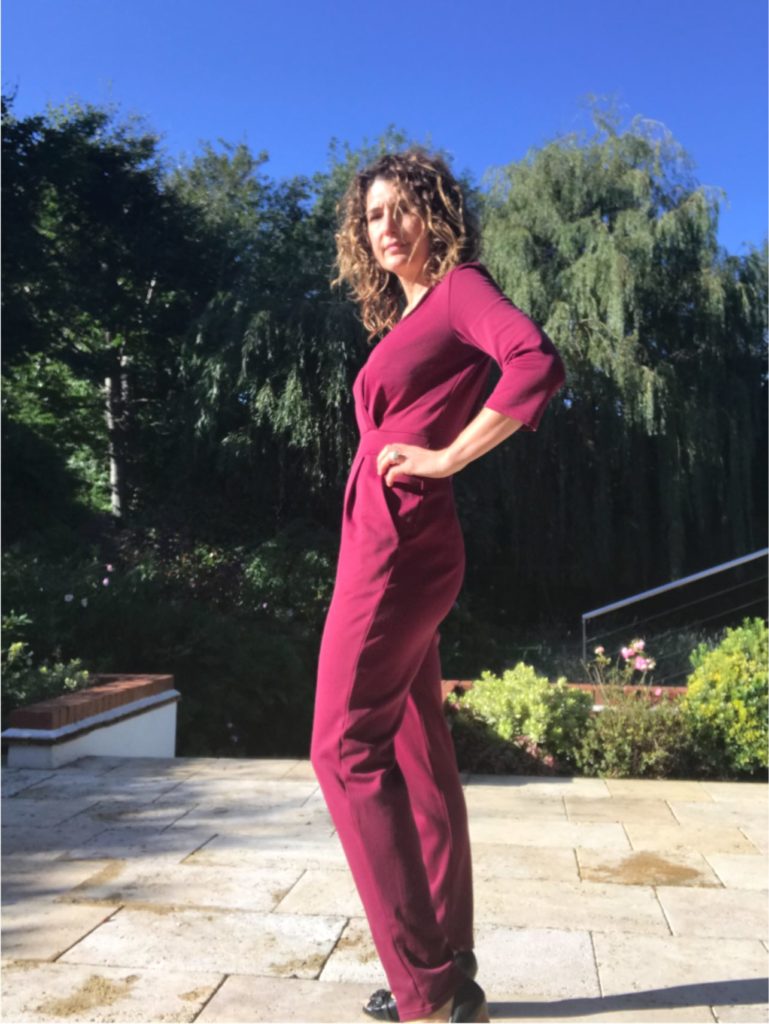
Winter officially starts on 21st December, so I have a week left to finish introducing my autumn sewing collection… Oh well… Today let me introduce a piece I could not miss: another Sirocco jumpsuit of course! And in my favourite Autumn colour, how predictable of me!
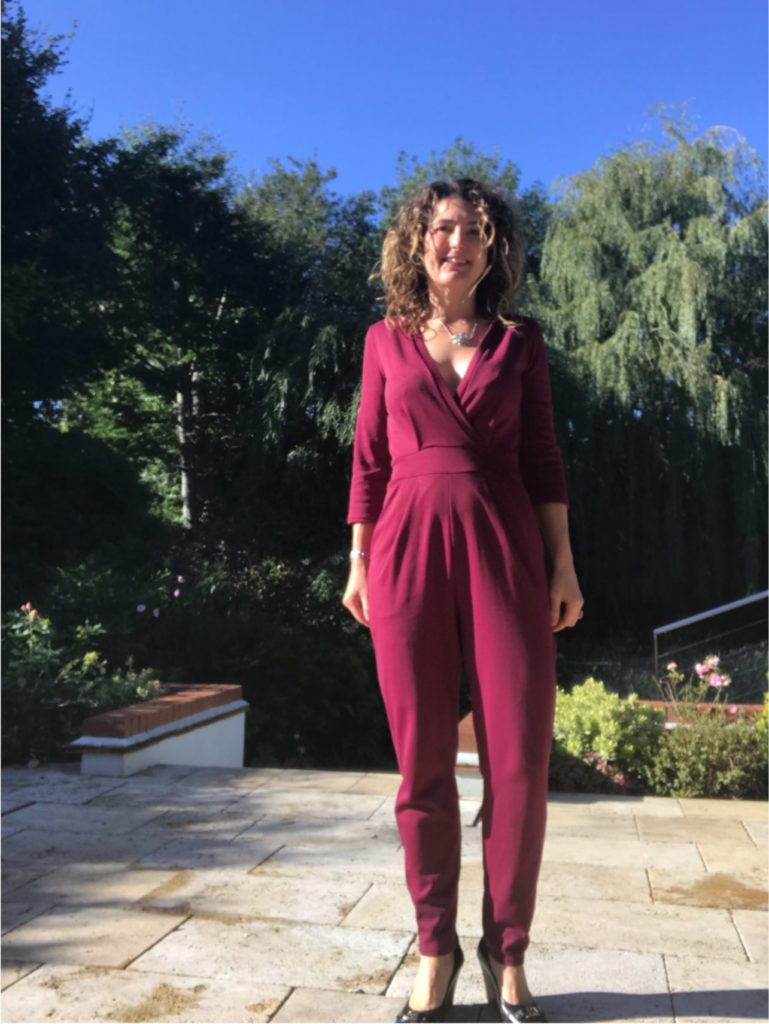
If you’ve been reading this blog for a while, you know I am an absolute Sirocco fan – see my black version here and my pink version here. This pattern is an absolute gem, I’ve seen loads of versions on Instagram and they all look stunning, whatever the shape of the person – truly incredible for a jumpsuit!
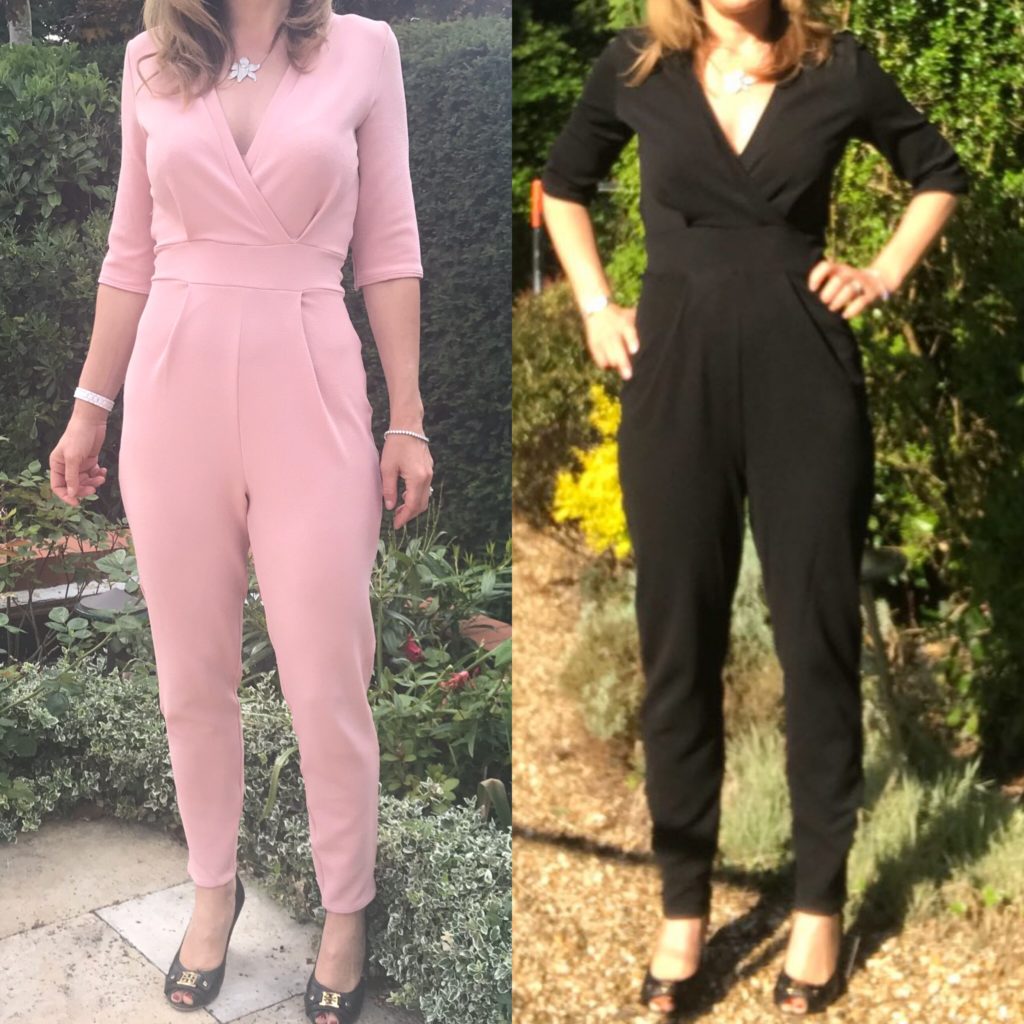
But despite its short sleeves on the enveloppe, for me Sirocco is more of a transitional piece, completely appropriate for Spring and Autumn – you just need to lengthen the sleeves, which I did for all my versions by simply drawing a straight line from the initial pattern sleeve lines.
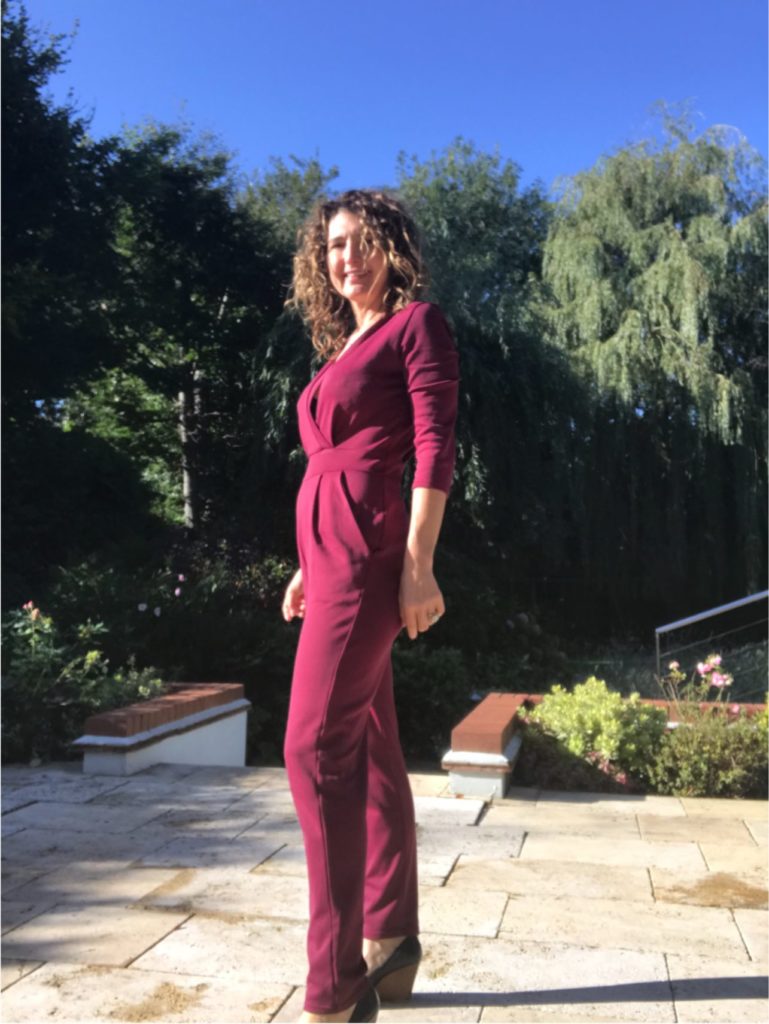
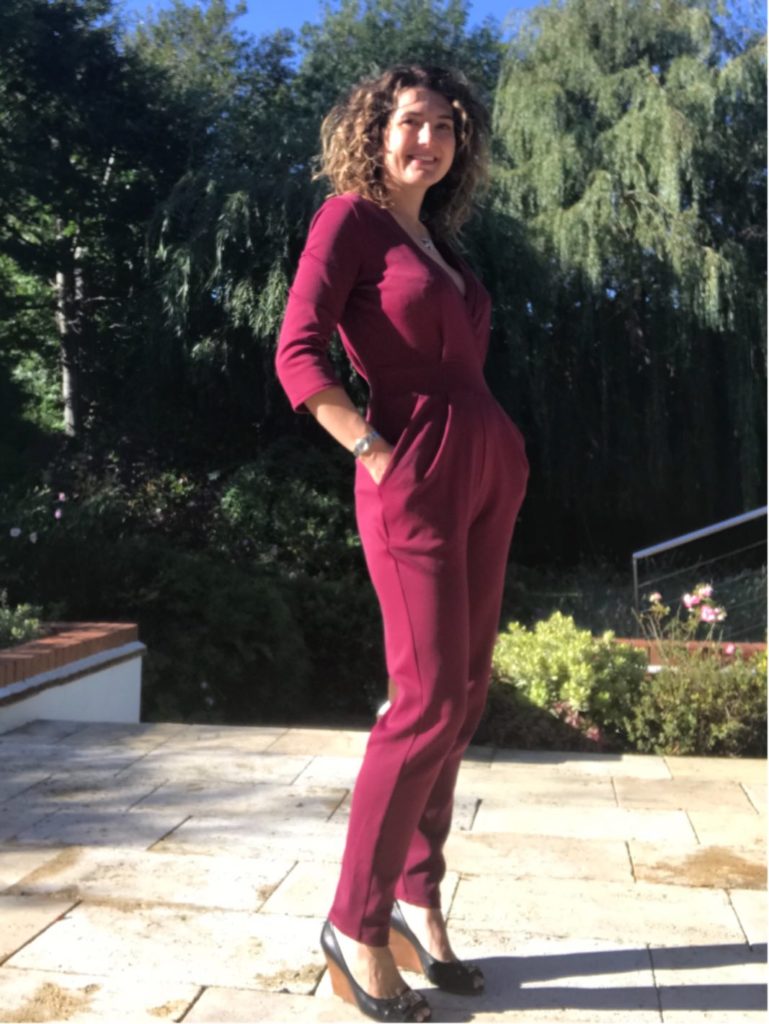
I would have loved a full sleeves version here, instead of the 3/4, but … I didn’t have enough fabric for both long sleeves and pockets!!! So annoying… I did omit the pockets for the black and pink versions, out of sheer laziness (and also because I usually hate the unnecessary bulk around the waist) , but I definitely recommend you keep them, they make a huge difference to the overall look of the jumpsuit.
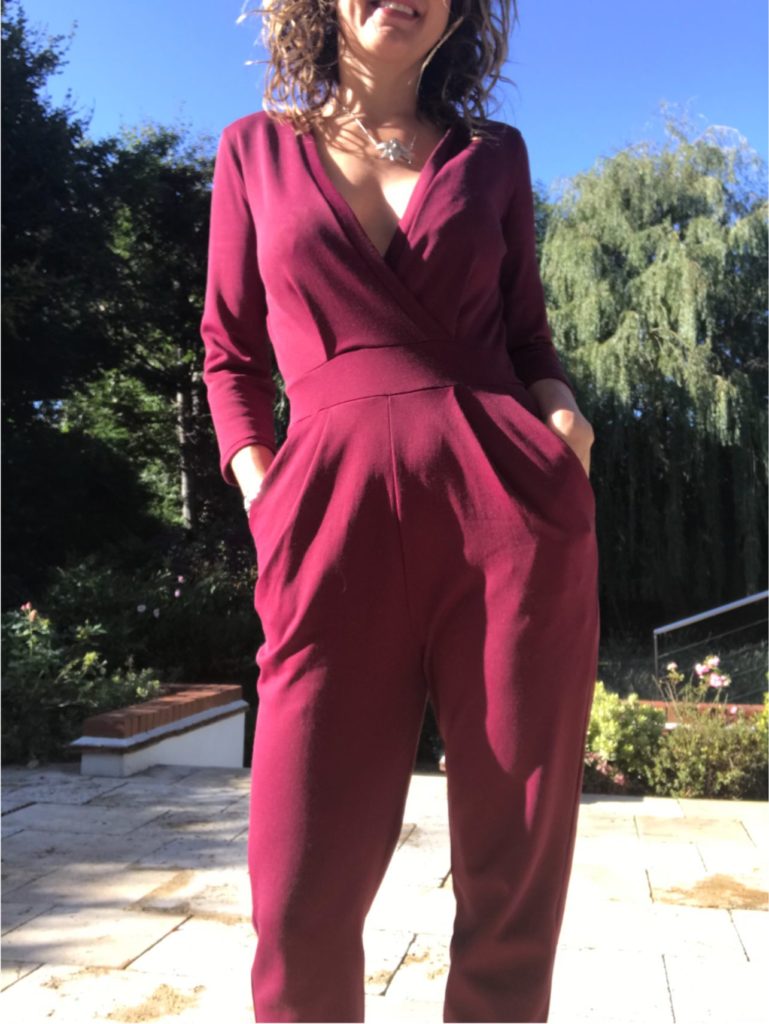
I am actually a bit disappointed by the outcome this time, which looks a bit too large and where the neckline in definitely very low. I think this is solely due to the fabric: my black and pink version where made from a stretch fabric with a lot of recovery, this burgundy version is definitely in a softer fabric – a mix between a scuba and a French terry, double-sided, very soft and beautiful actually! I am wondering if I should re-cut the pattern one size lower (and make all my previous adjustments) if I want to work on “saggier” fabric – such a hassle, I will need a lot of motivation for that!
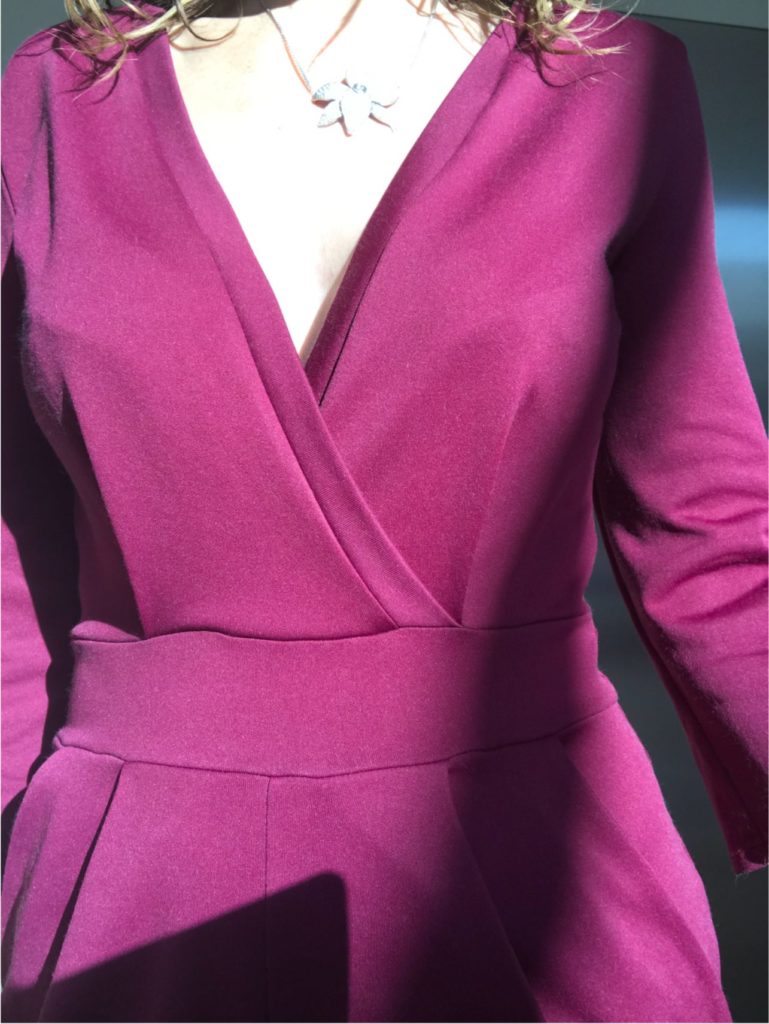
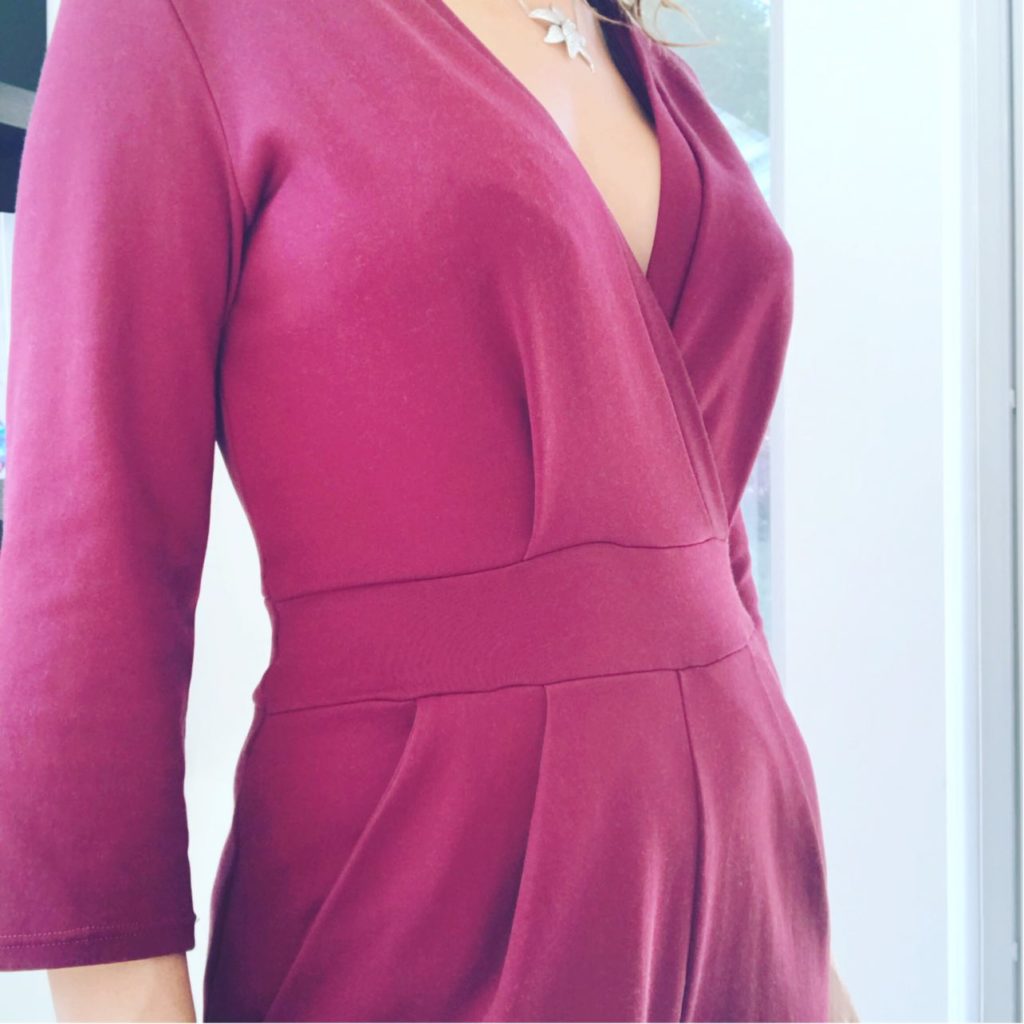
In any case maybe I should just not bother, I got a lot of compliments each time I wore this jumpsuit, and I love this colour so much I am not too bothered about the fit, for once!
Just for reference, all the changes I made to the pattern (as well as pictures of the various colourful muslins) are detailed in this article.
Sewing for Autumn: Soft as Velvet
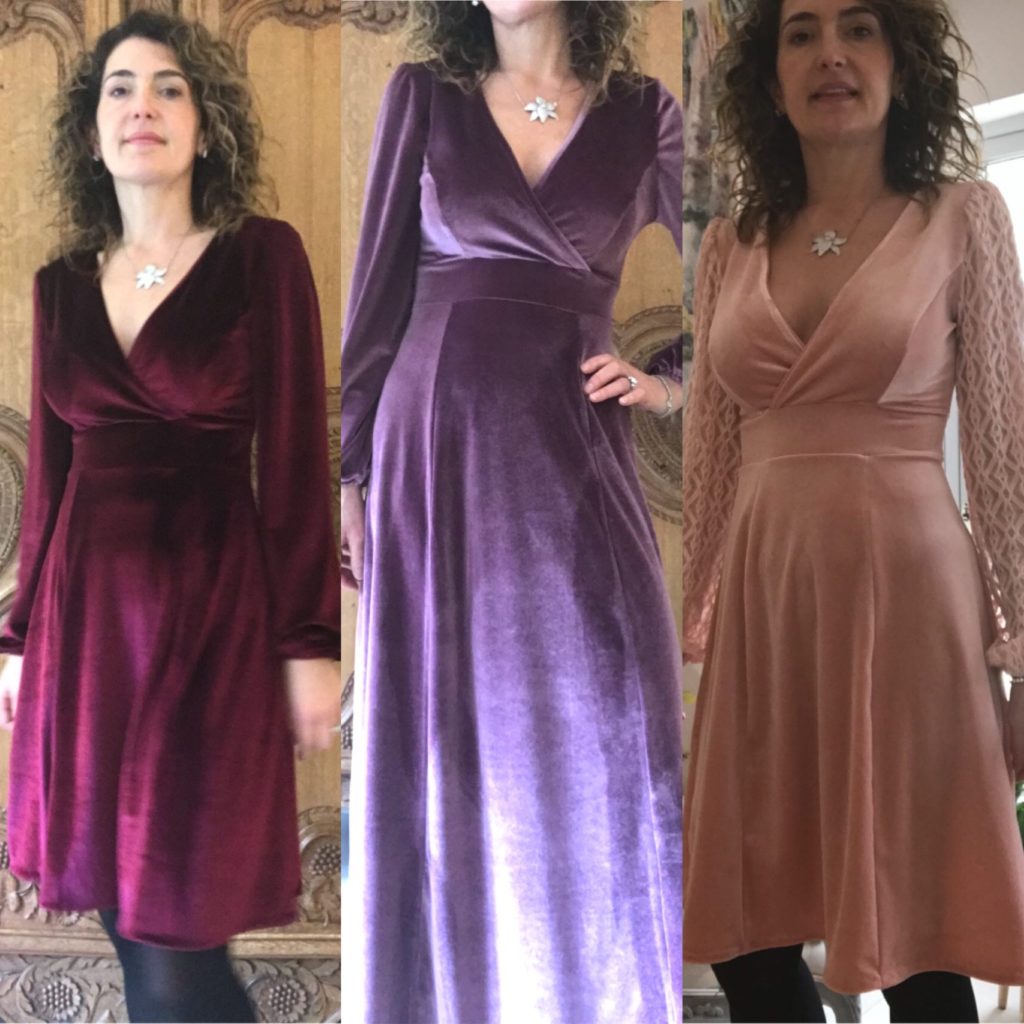
Let’s continue my Autumn series by introducing you to my favourite pattern in my favourite fabric for this season: the Deer&Doe Magnolia dress in stretch velvet. And you know me: in my enthusiasm, I haven’t stopped with one or two dresses… I have actually sewn three, all in my favourite seasonal hues discussed in my previous article.
Magnolia is a pattern I had been wanting to sew ever since it was released. But I have a large bust and after discovering the McCall and Vogue Custom Fit patterns with different bust cup options (winter dresses sewn here, here, here and here) I just stopped looking at anything that would potentially require a Full Bust Adjustment (FBA for those familiar with this long process).
How stupid of me!!! I finally decided to try and sew Magnolia without making any FBA and… it worked perfectly!!! D&D patterns already size more generously at the bust than other indie and regular pattern companies and I also think the princess seams offer a bit more room for the bust. I cut a size 38, in line with with my measurements (except bust) , and all of my E cup fit in there – I just had to reduce very slightly the waist.
But Magnolia is a pattern for non-stretch fabric so my first trial version is this one, in a light viscose, with shiny piping of course!
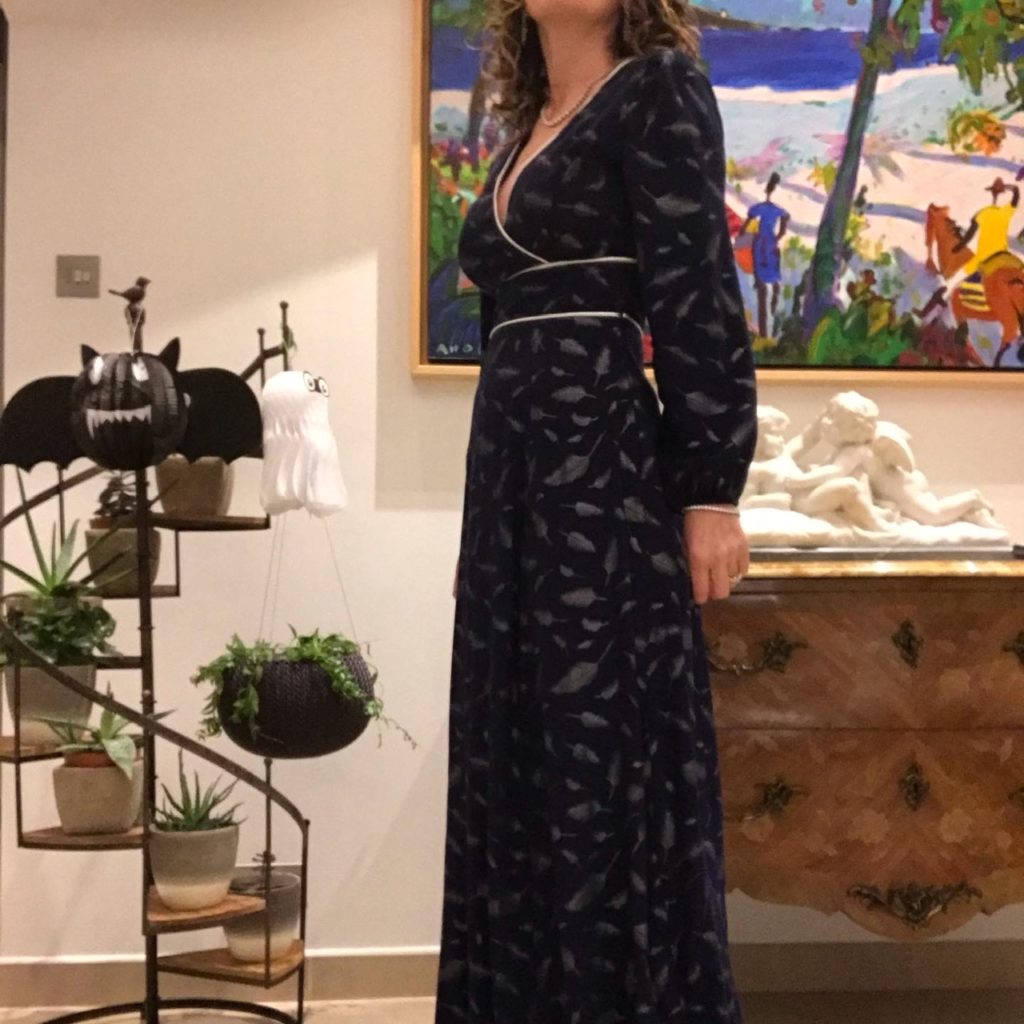
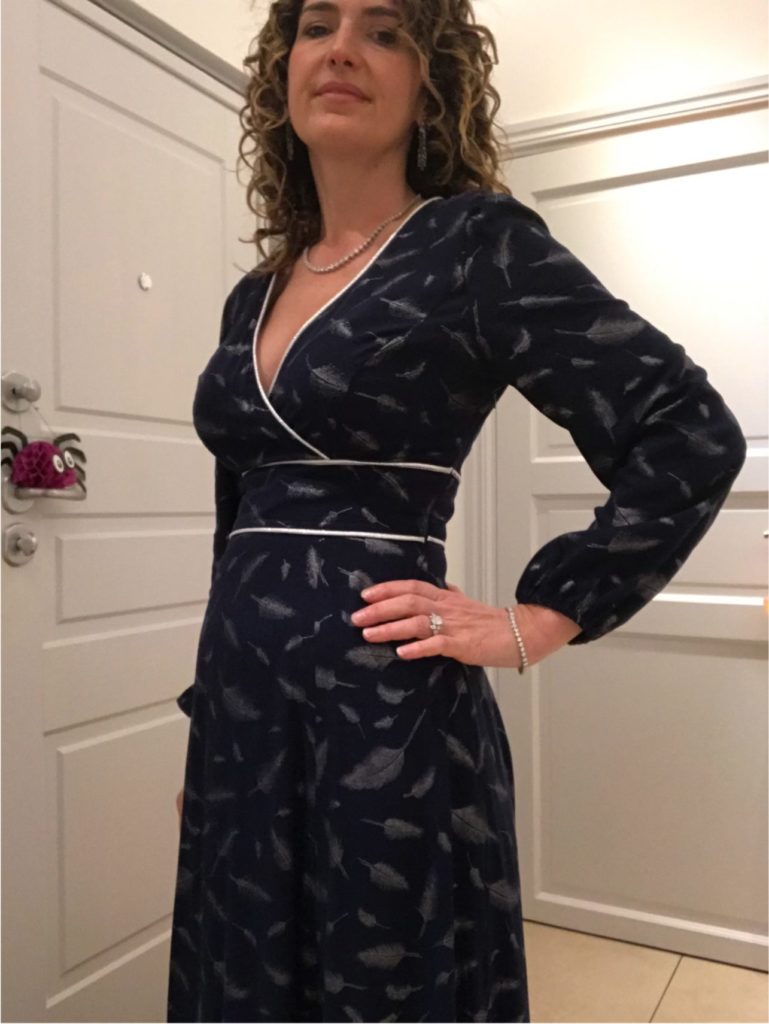
This dress is beautiful and I was over the moon with the outcome, but it is frankly not very appropriate for winter, as the fabric is very thin hence not very warm – for me anyway! I therefore decided to explore thicker fabric but still with drape; and stretch velvet came as an obvious candidate: it is very cosy, completely straightforward to sew and, importantly, all over the place in fabric shops. My favourite providers are Croft Mill and Fabrics Galore,
Here are the adjustments I made to convert the pattern for a stretch fabric:
- I should really have gone a size smaller but I did not – I put the dress together in size 38, then before hemming it I tried it one and shaved off whatever was not necessary (depending on the stretchiness of the velvet, this was between 1 and 1.5cm). I know this is not the right way to do it but it worked really well.
- I omitted the side zip, not needed with the stretch of the fabric.
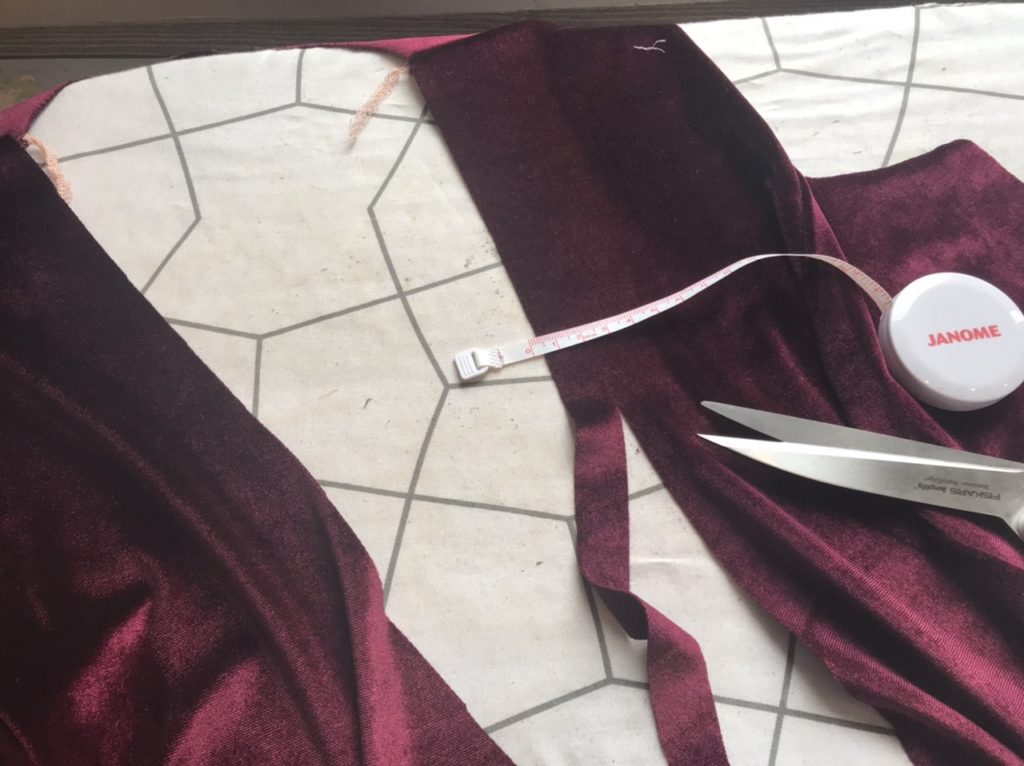
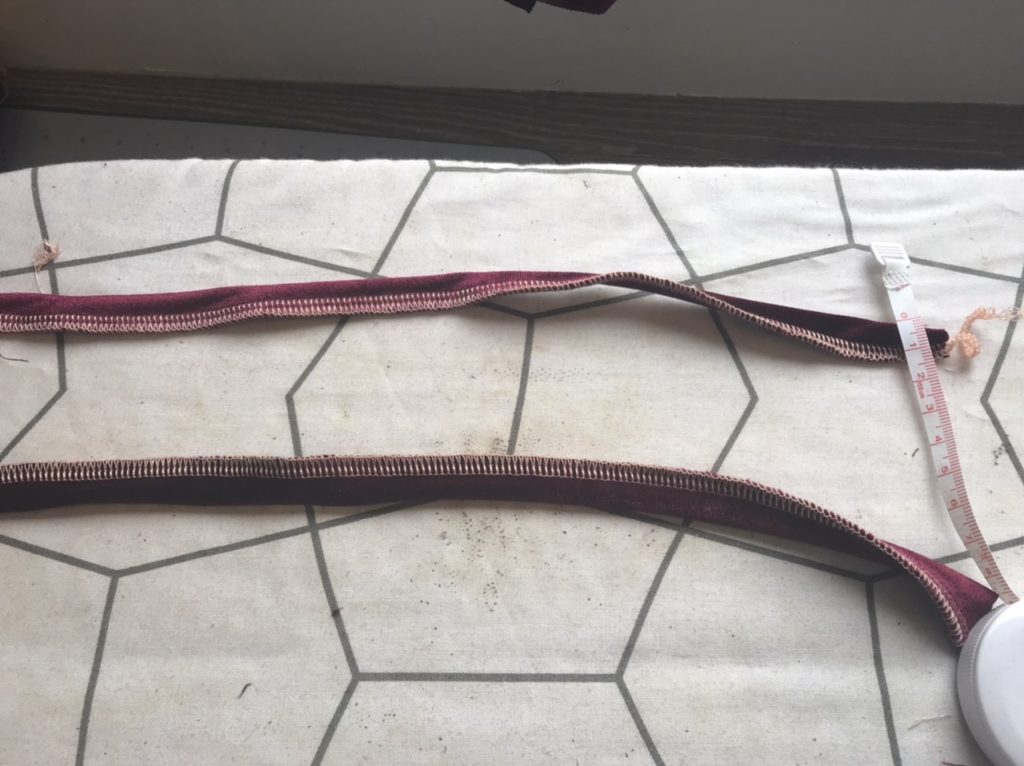
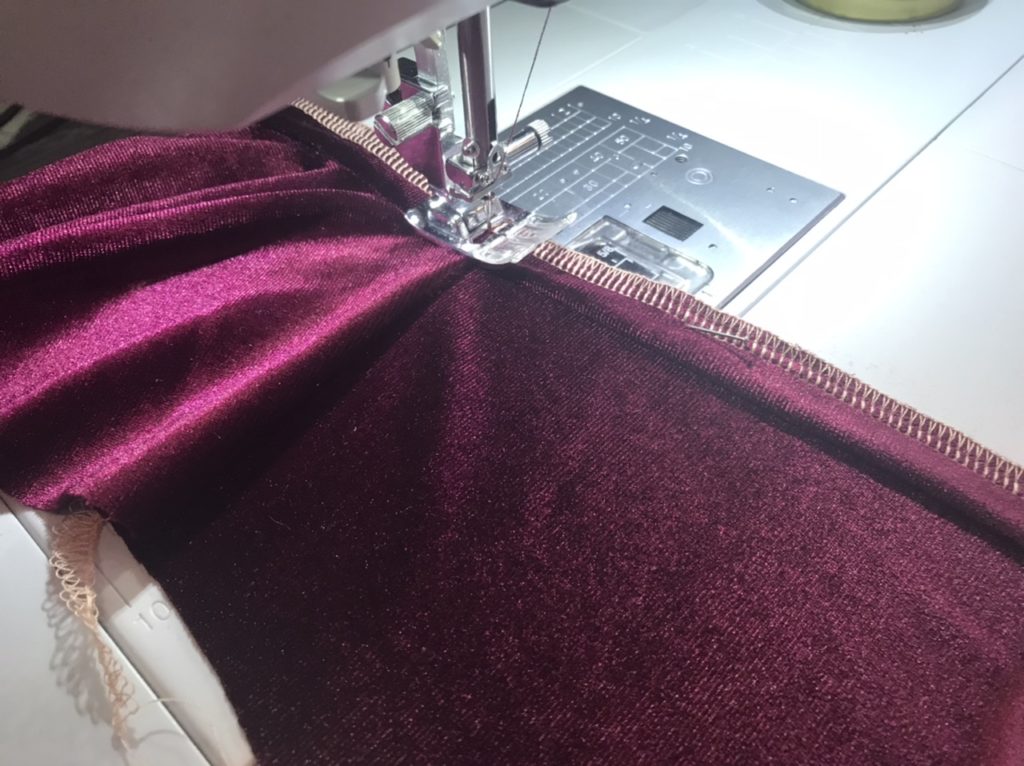
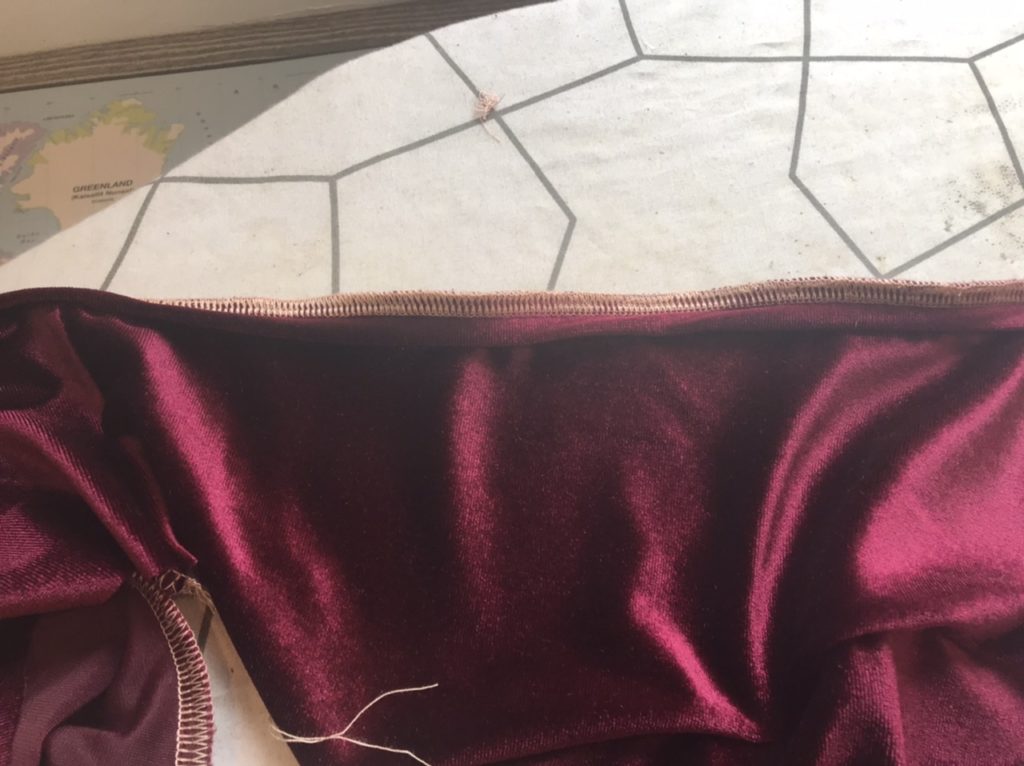
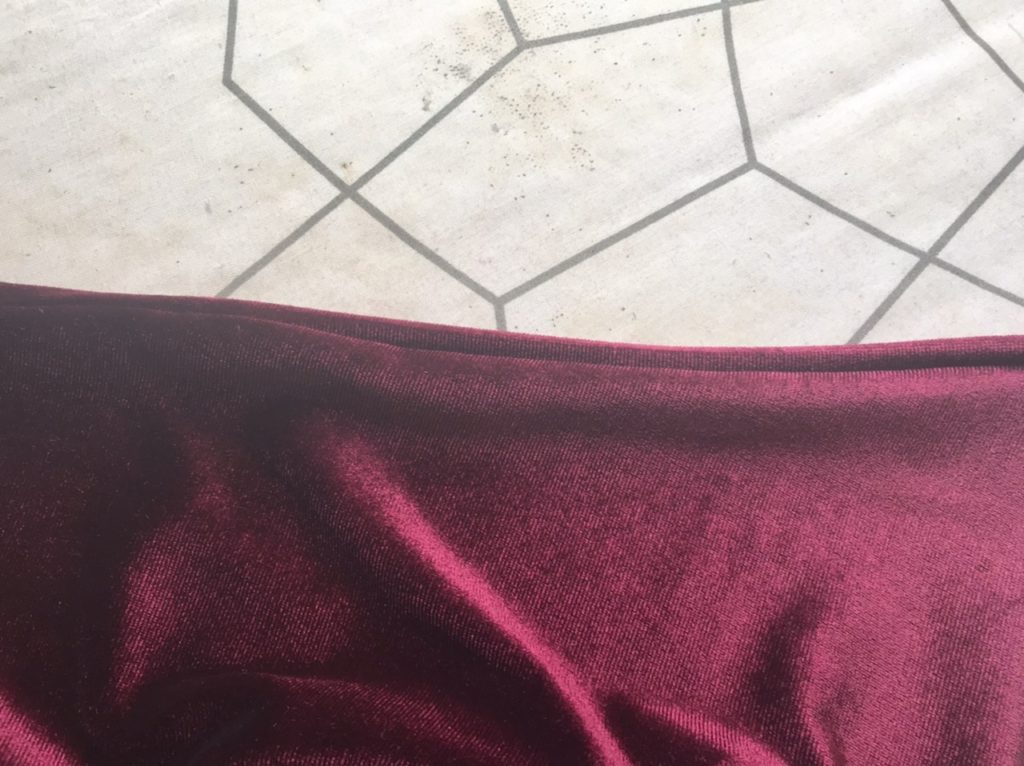
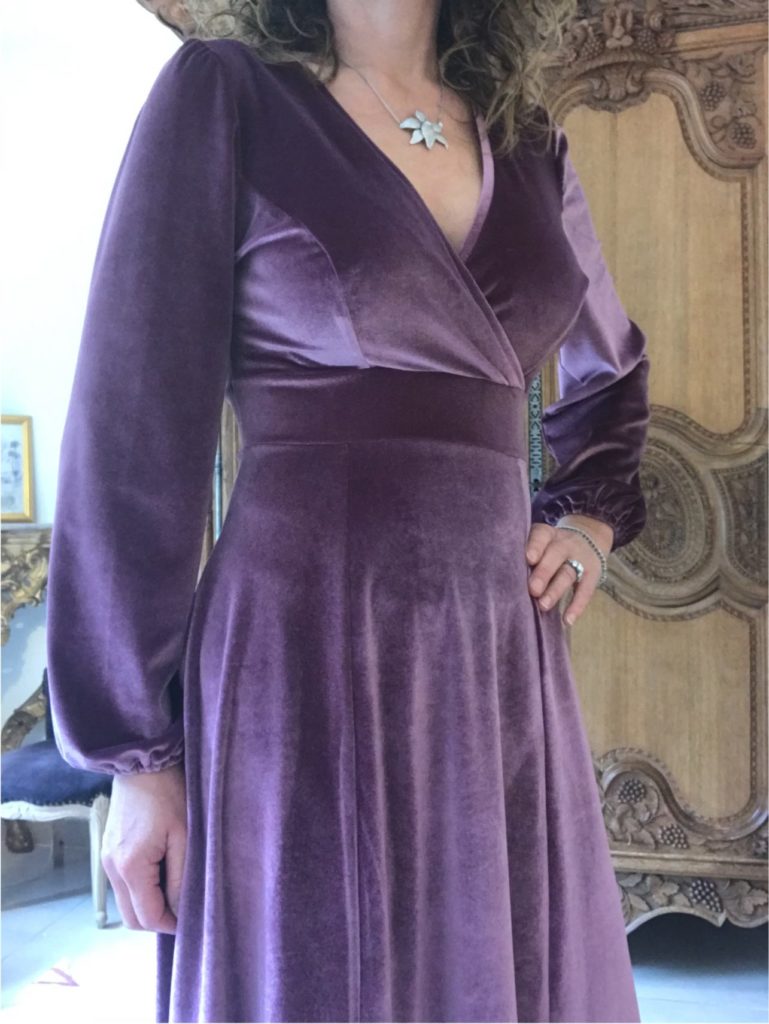
- To finish the neckline, I cut 1cm off the neckline, then cut a velvet band 3cm wide and the lenght of my neckline. I folded this band in two, wrong side to wrong side, overlocked the raw hedge, then assembled it to my neckline with an overlocker – the way you finish off the neckline on a tee-shirt but without making the band smaller.
- I assembled everything with my overlocker, but hemmed by hand (for an obscure reason I really like thIs process, weird…)
Here are the picture of the neckline finish, which is the main adjustment I made to the pattern:
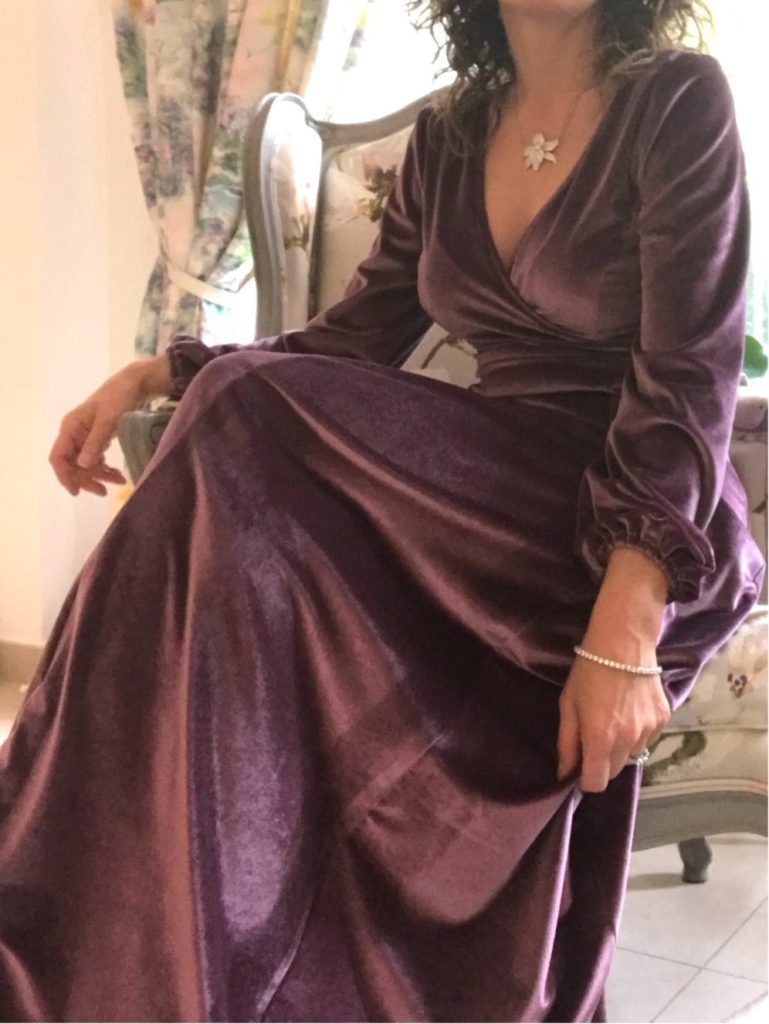
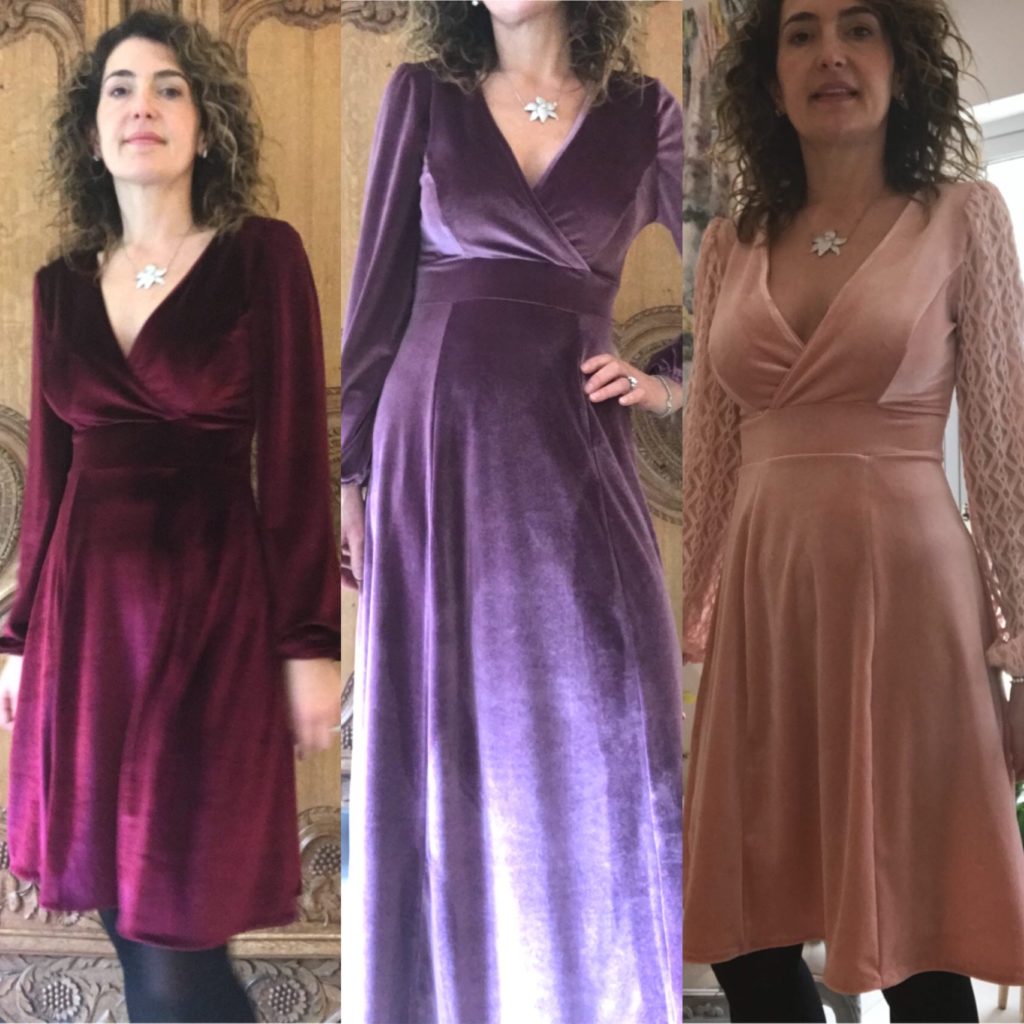
And that’s it. Three dresses! First a long lilac one – I did not keep the side slit in the skirt but now I think I should really have. This dress looks very elegant but is a true secret pyjama, it is incredibly warm and cosy!
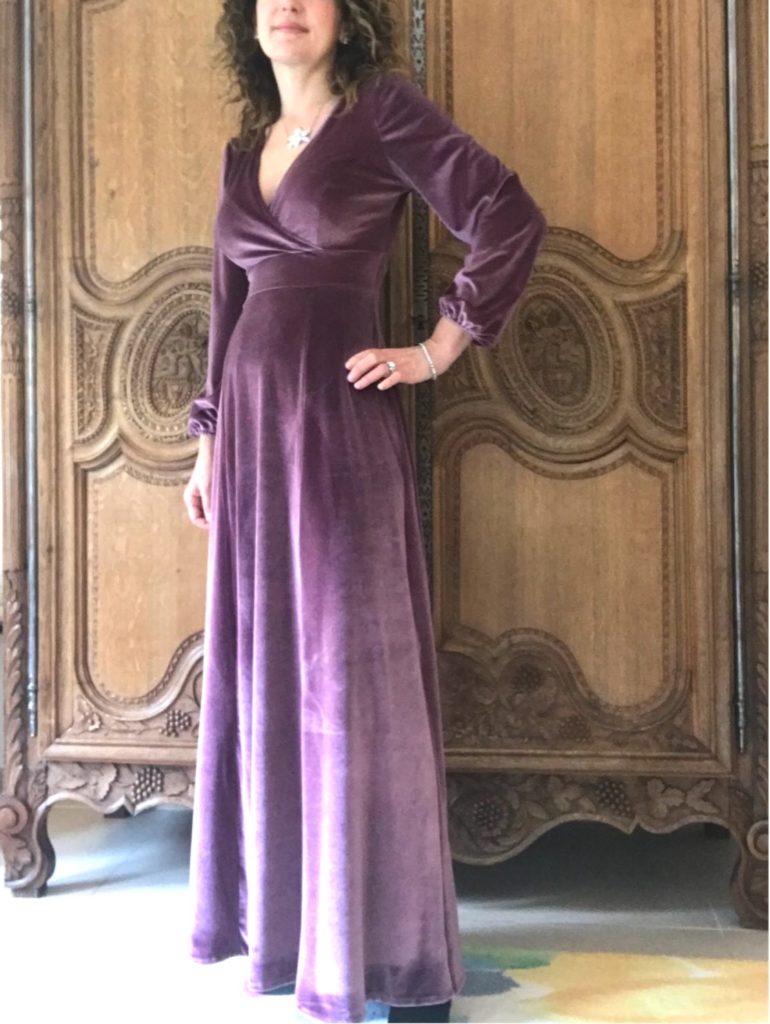
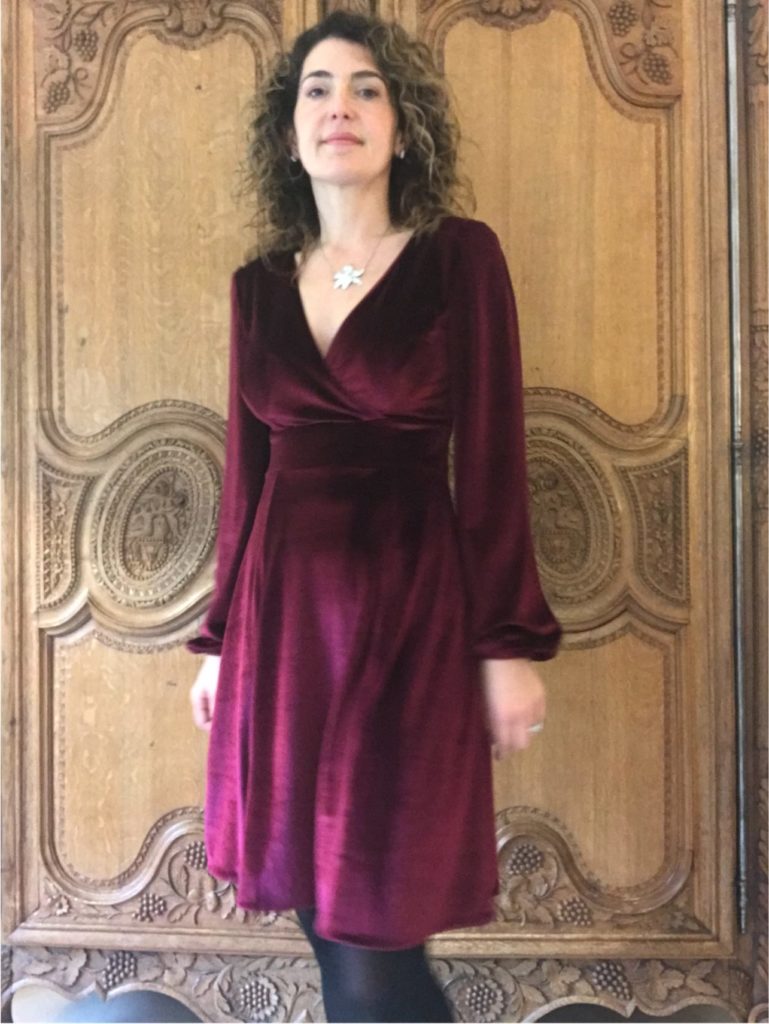
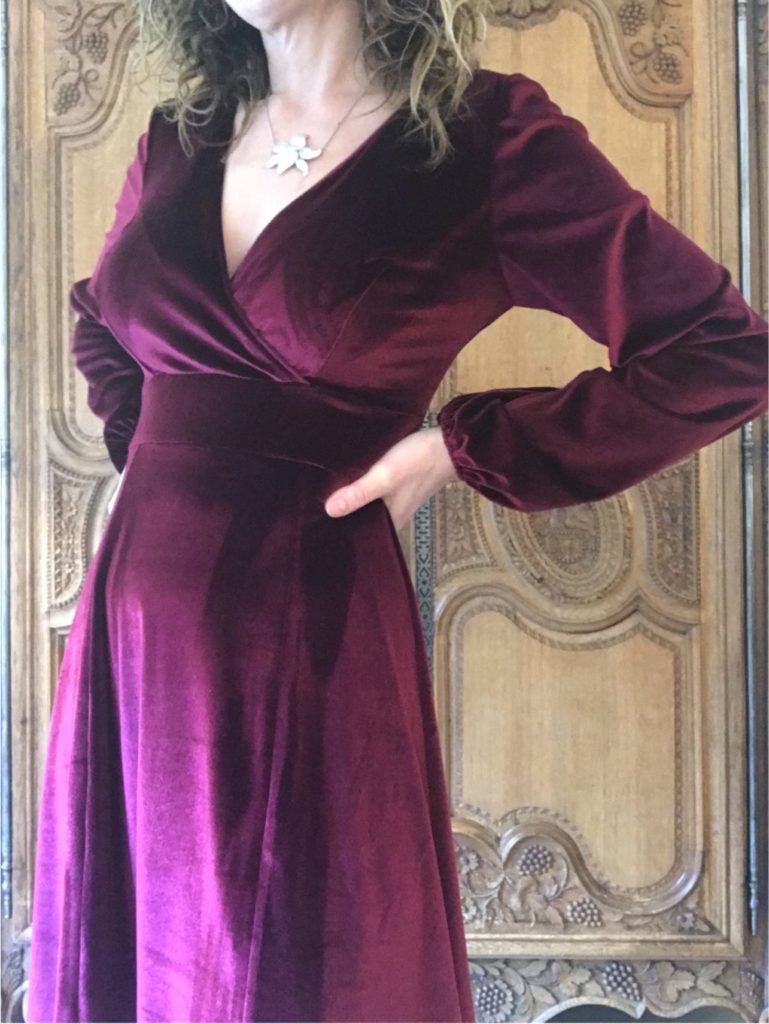
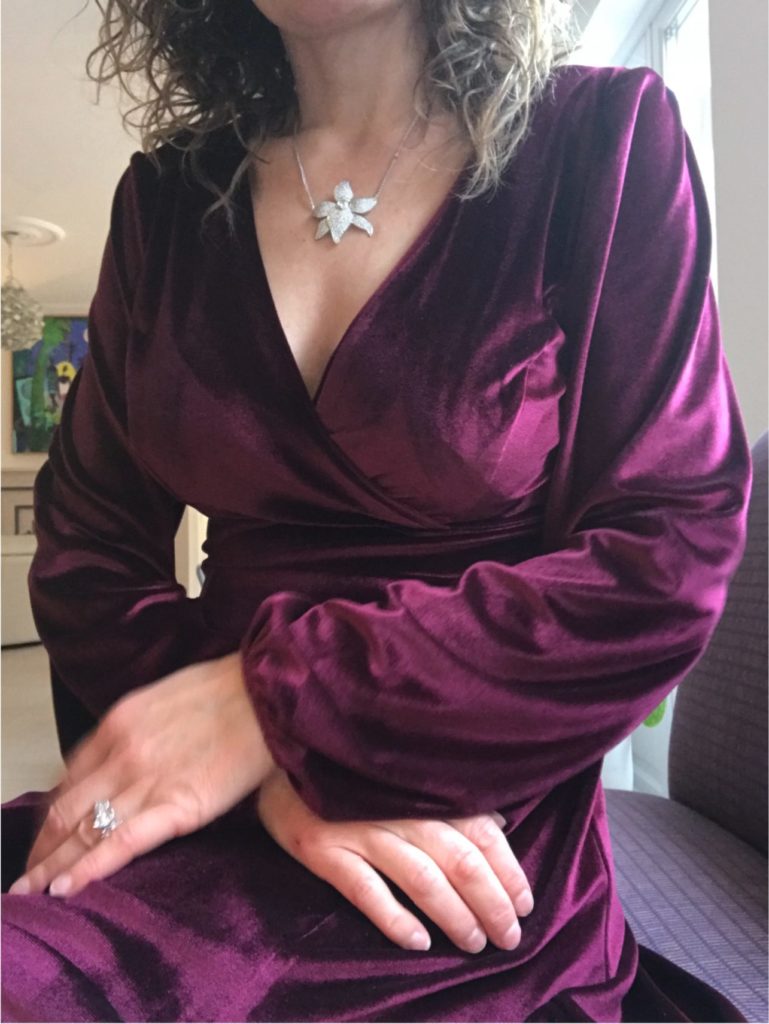
The second one is wine-coloured and my favourite – I am absolutely in love with the colour. I lengthened the sleeves by 5cm and made the wrist elastic slightly smaller than indicated (19cm), I find it more comfortable this way.
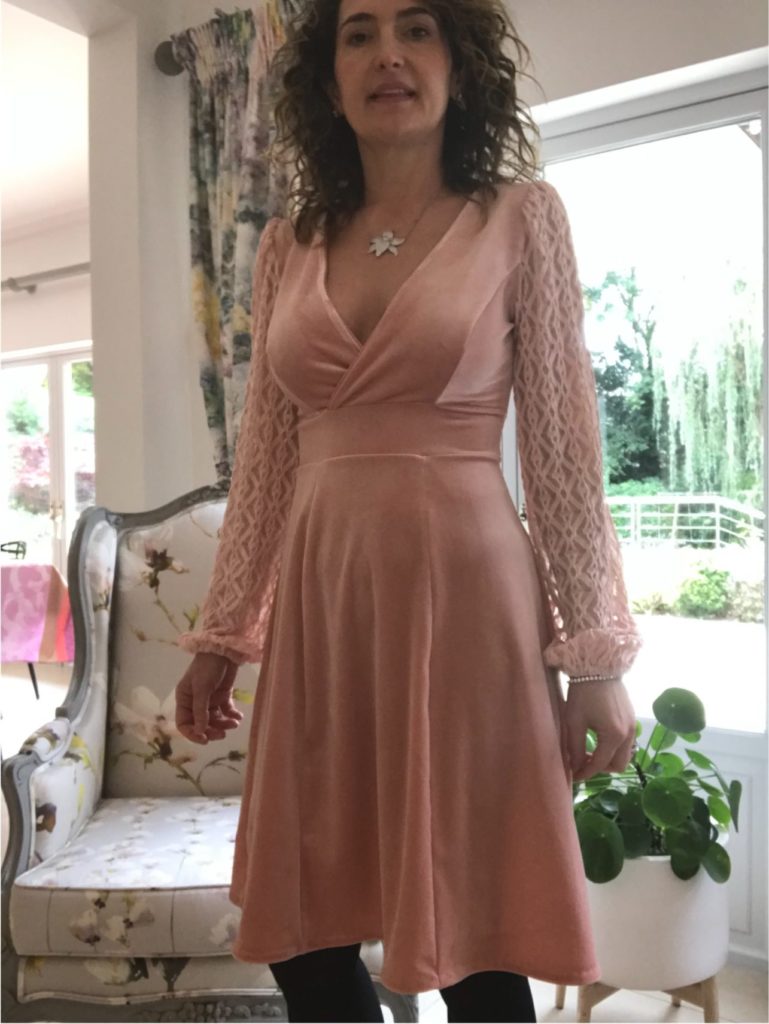
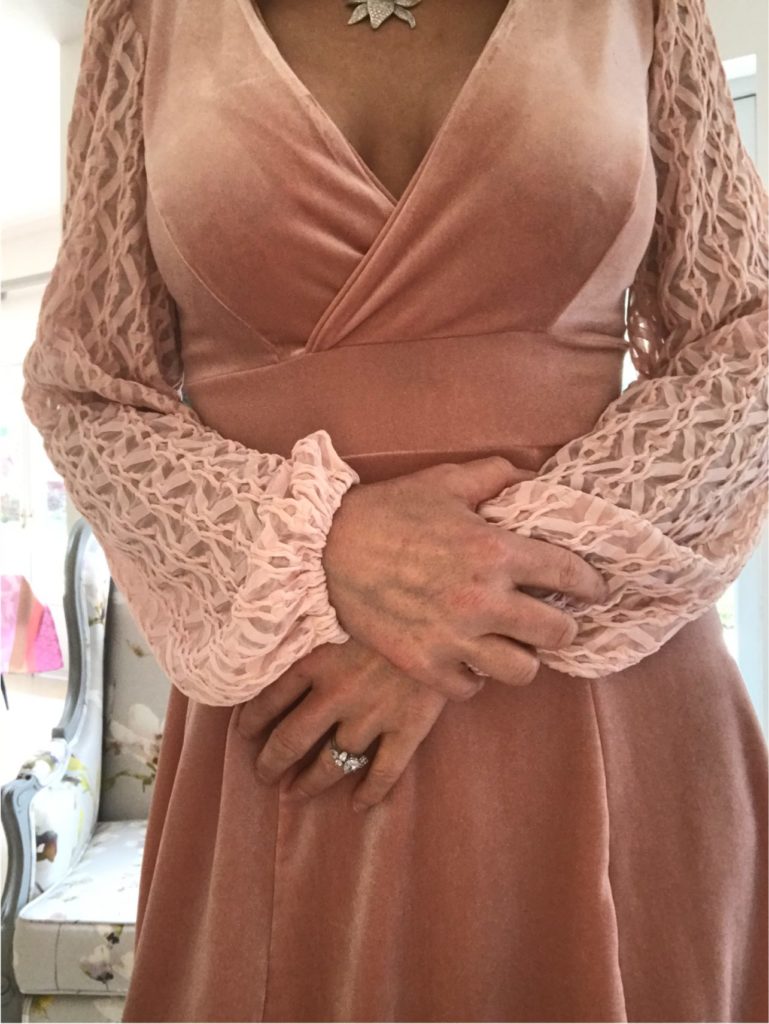
For my last version, in blush pink, I used a stretch lace fabric I had in stock for the sleeves – incredibly perfect match to my velvet! I slightly messed-up the neckline which is now very revealing… Oh well…
That’s it for these, but I promise there are more Magnolias to come soon…
Sewing for Autumn in Wine Hues
Although my writing has been rather light on the ground over the past few months, my sewing has far from stopped! In fact since September, I have been very productive sewing my Autumn wardrobe, as the weather turned cold extremely fast and I was attracted by new colours. Well, actually, should I say one specific colour?… Which is…. guess!
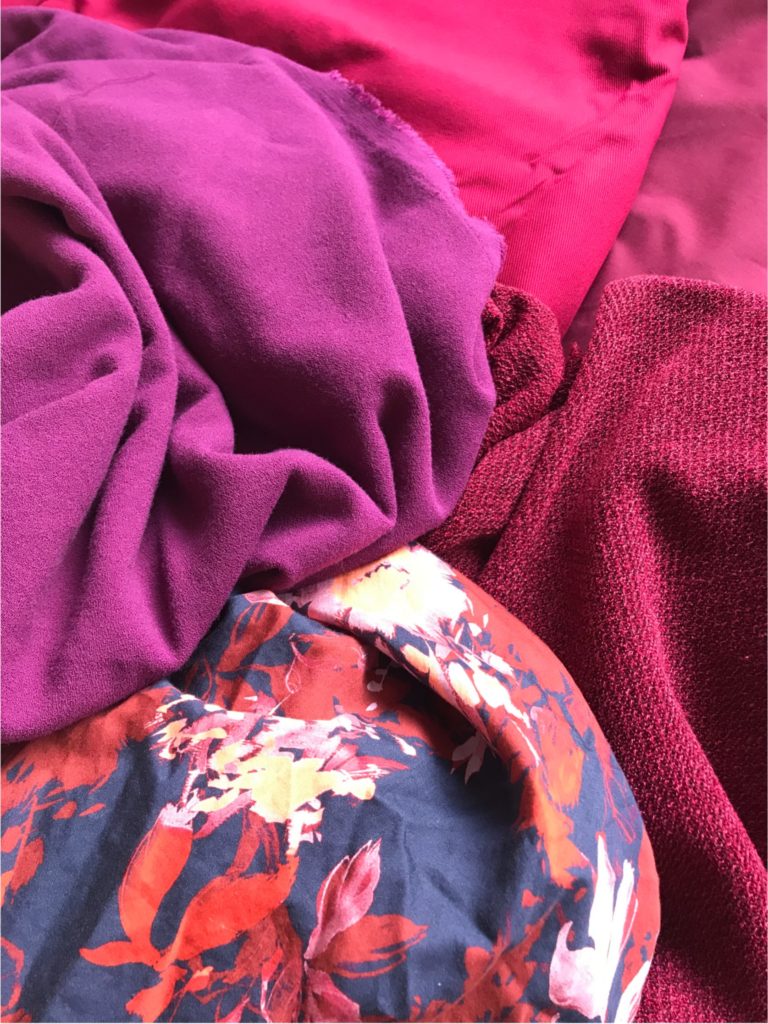
Not sure what this colour is called: wine, burgundy, damson, mulberry? I like it with quite a bit of red and purple, not too much pink (definitely not fuschia!!!) – on the Pantone charts I think it would sit in between 208, 209, 215 and 216.
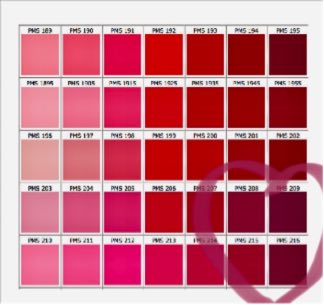
Obviously a huge struggle to order from the internet because very often, the colours shown on the websites have nothing to do with the real-life colours – this is the case with other colour tones but not to such a huge extent in my view.
So to help you purchase fabric if you share the same colour obsession as me, here is a little selection of what I’ve bought and loved in this tone – and is still available to order at the time of writing this article. For all these fabric I actually ordered samples first, as the colours from the website pictures can be very inaccurate ( and I’m really fussy about my colours, in case you didn’t notice).
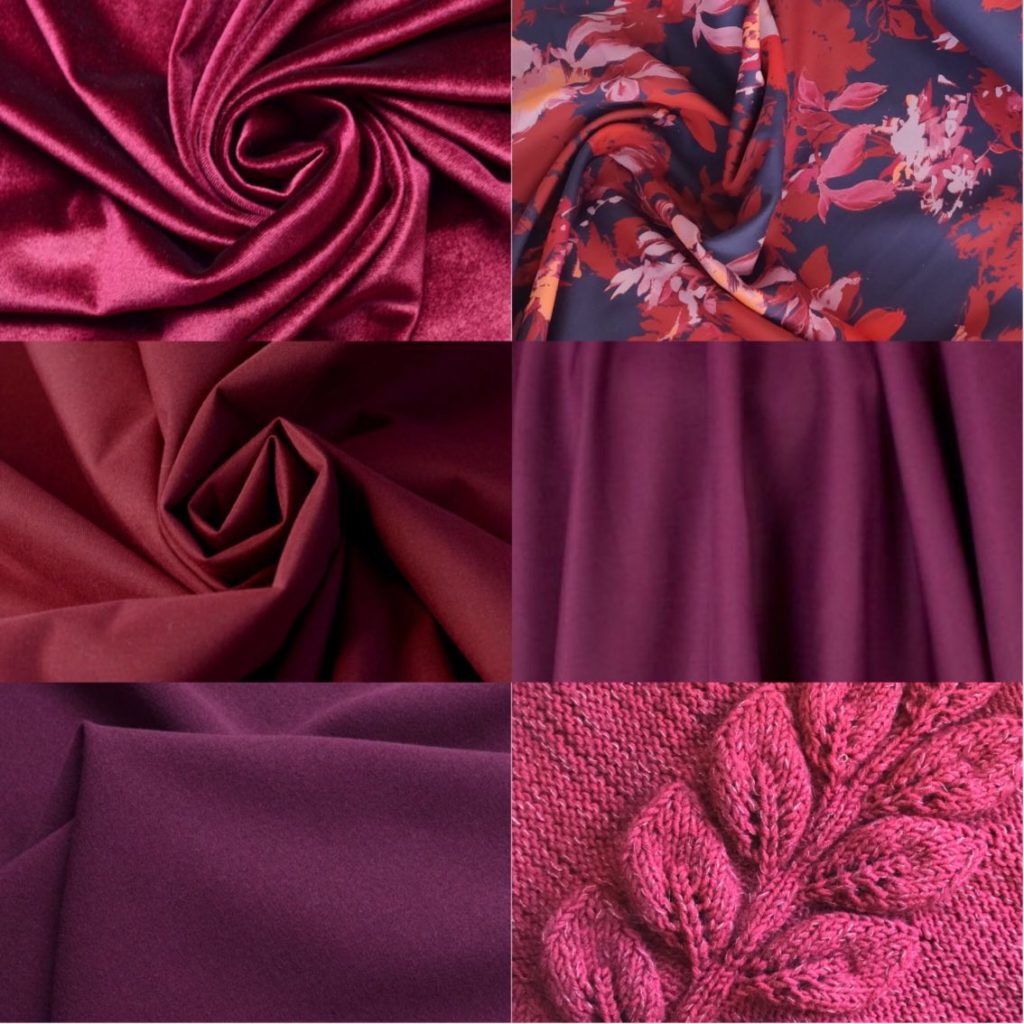
From left to right and top to bottom:
- Wine stretch velvet from Croftmill
- Winter-toned cotton sateen from SewMeSunshine
- Damson water resistant peachskin from Croftmill (the website photo is not acurate at all)
- Burgundy cotton twill from SewMeSunshine (the colour on the website is completely misleading, this fabric is a deep beautiful burgundy colour as shown here, not a bright fuschia)
- Damson crepe from Croftmill (here the website picture is spot on)
- And off course a bit of wool: jumper in a mix of Drops wools – Big Merino Maroon (here too the website picture is all wrong, this is a burgundy beauty not a brownish horror ) and Dark Rose Kid Silk.
And without further ado, here are my recent makes in this colour schemes.
Yet another Sirocco jumpsuit:
A series of stretch velvet Magnolia dresses:
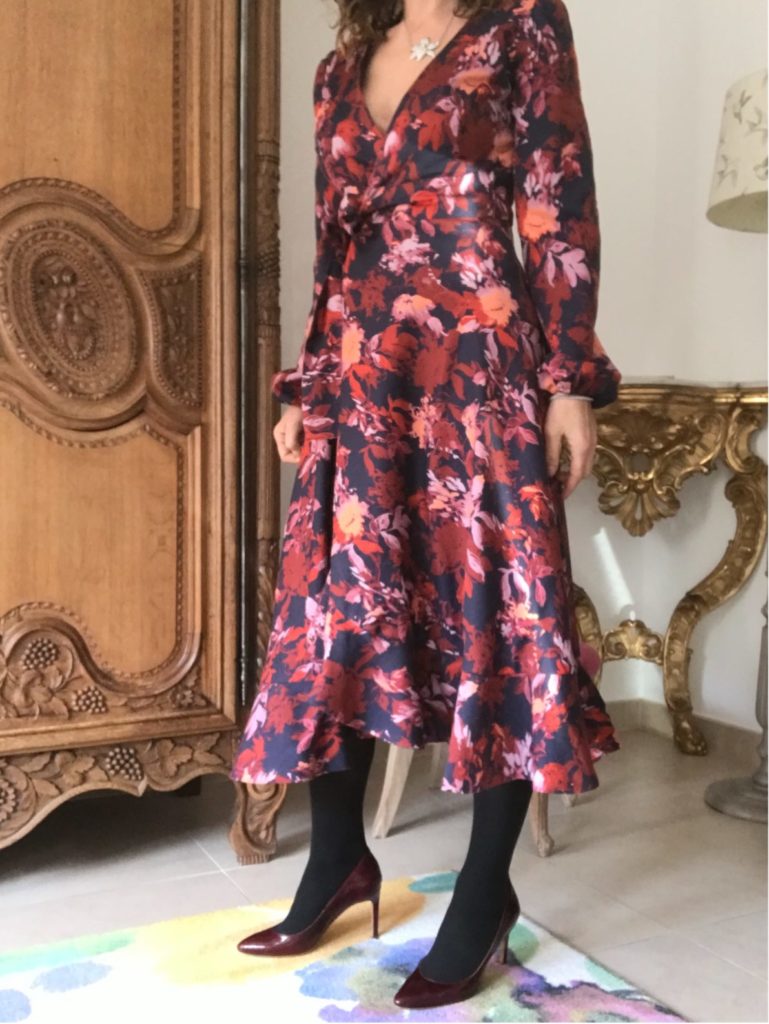
A dress from a mix of the Magnolia dress and the La Boheme skirt:
A cute little Ondée top:
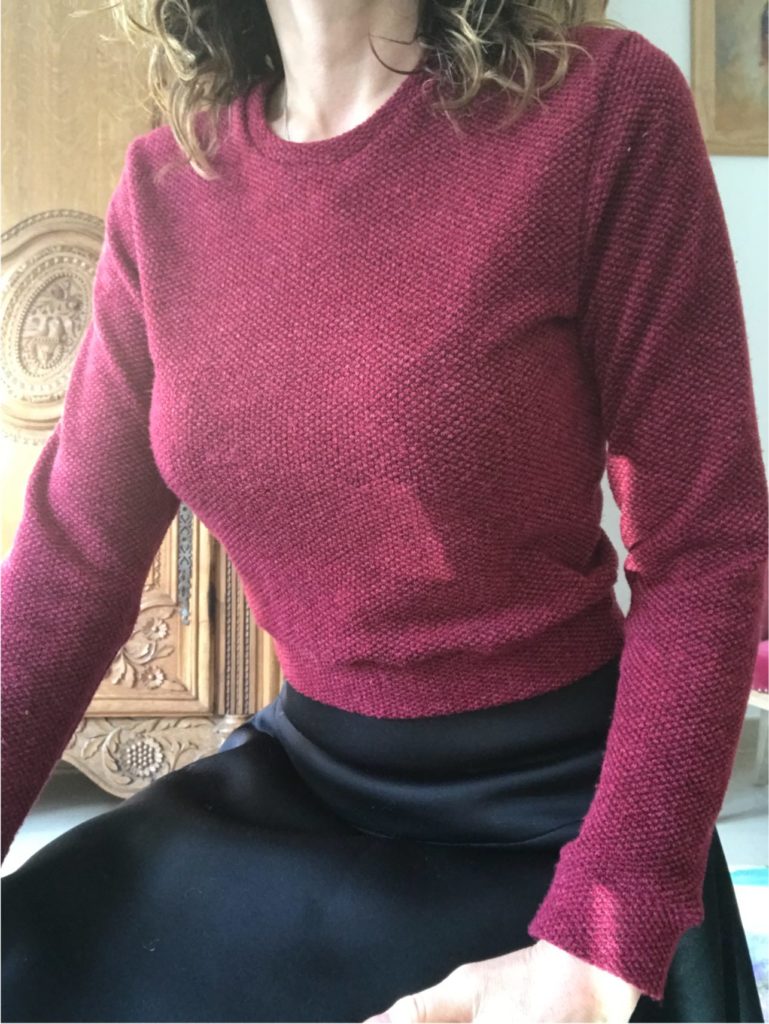
And a self-drafted knitted jumper, still in the making…
More details on most of these projects in forthcoming blog articles, soo, I promise!
Tutorial: Maxi Dress, Tiered and Shirred
If you make a smocked dress with one of my tutorials, do not hesitate to use the hashtag #smocksmignons so that I can admire and re-gram it!!
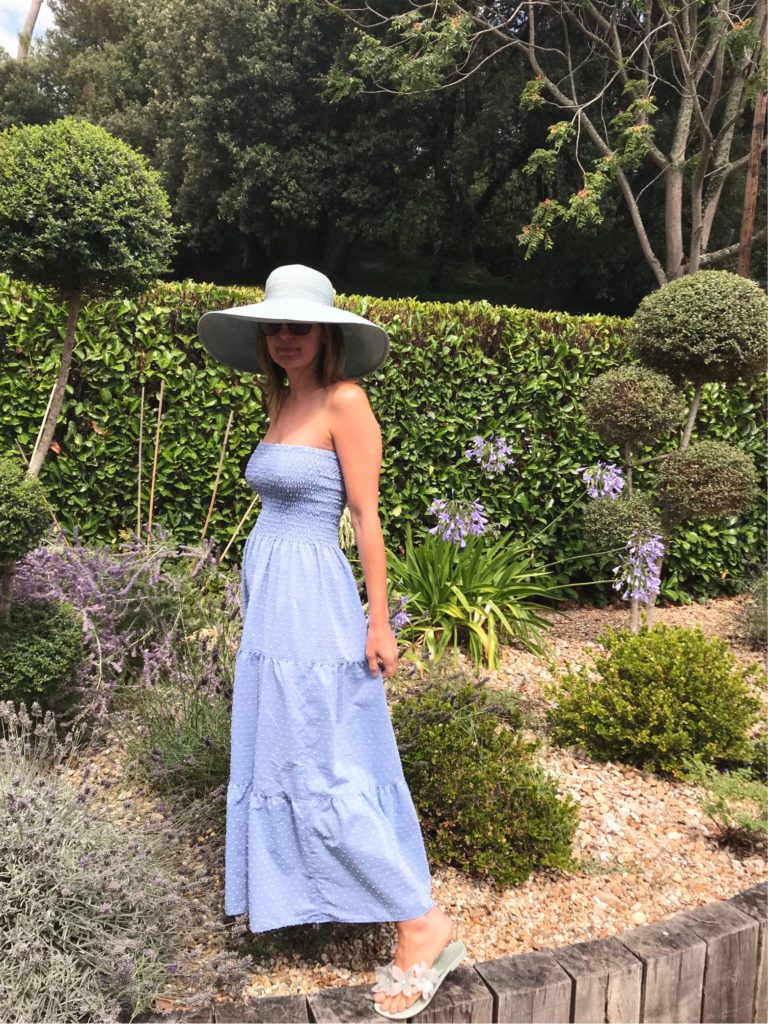
After sewing eight of these dresses last summer, I though I was done and over with shirred dresses with ruffles… Well, apparently not!
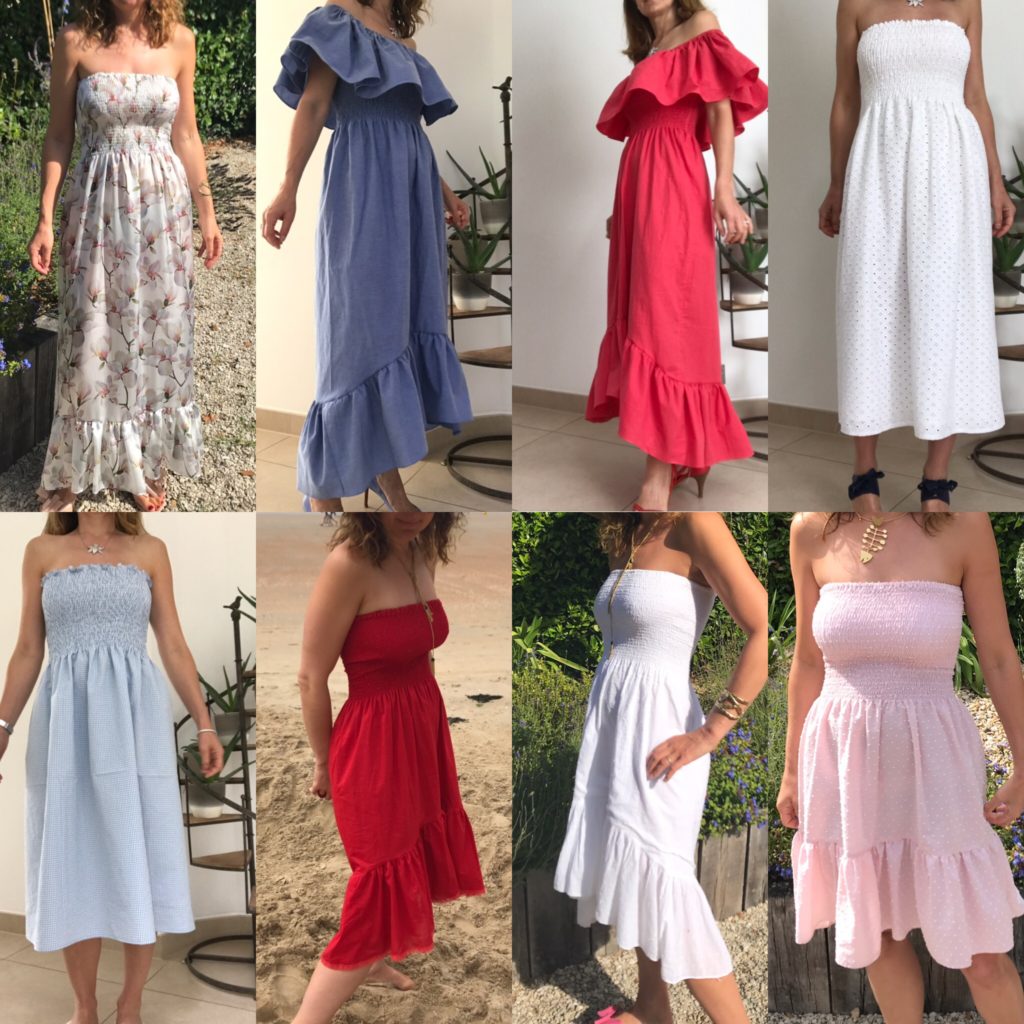
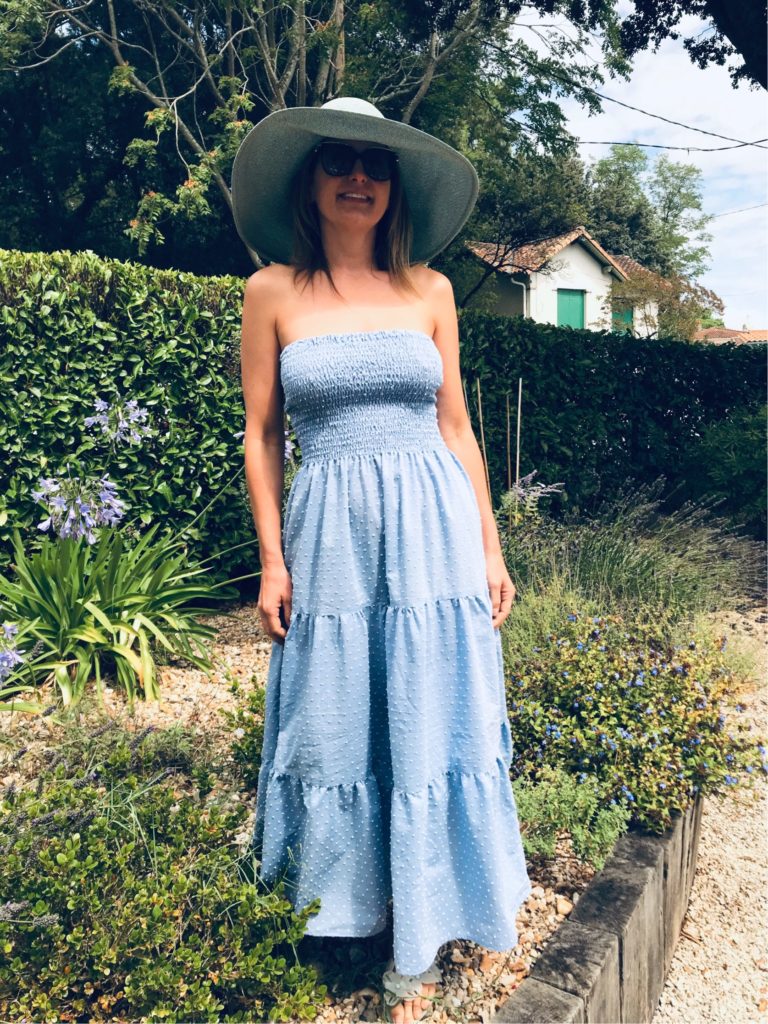
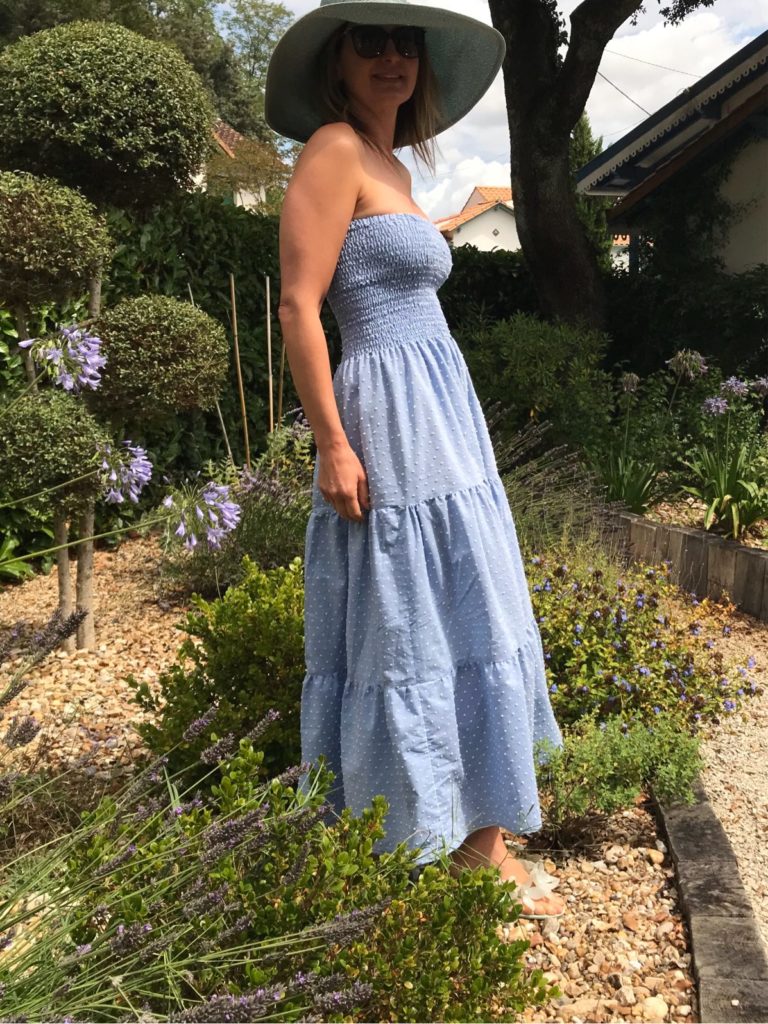
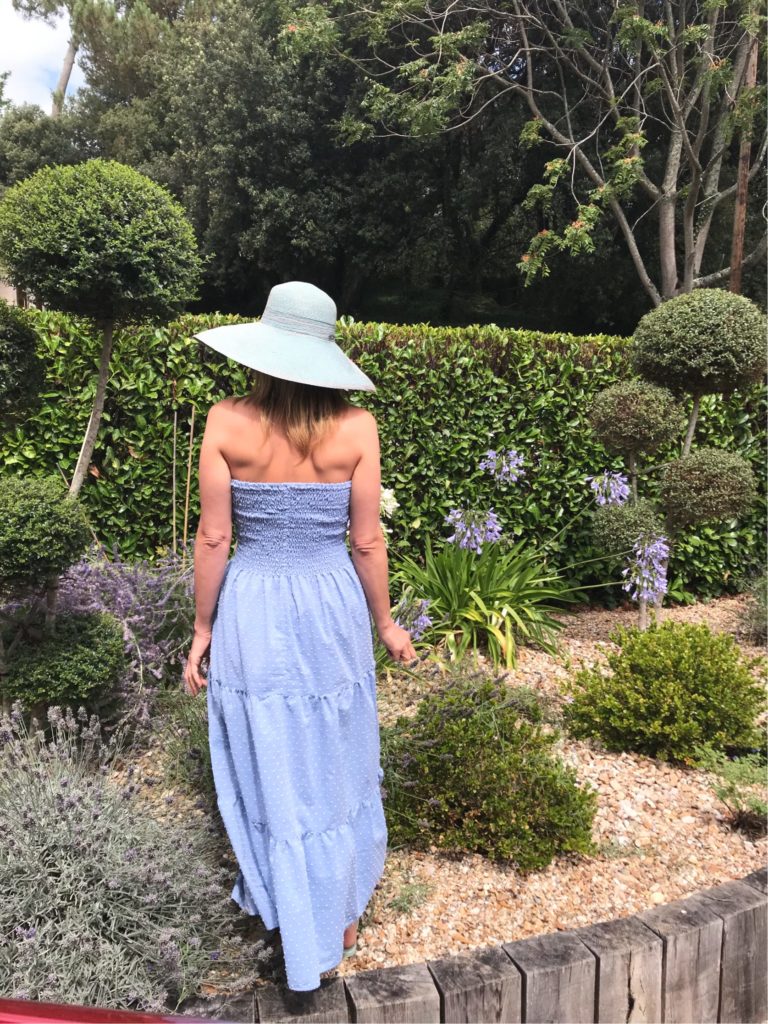
This year, I had something quite precise in mind: a maxi dress, with a shirred top as usual but also with tiered ruffles. However I pondered for ages about the proportion: how long and wide should the ruffles be to get the right proportions? In the end I think I nailed it down, so if this dress inspires you to sew something similar is here the full tutorial!
SUPPLIES
- 2 x 1.5m of fabric (or width 1.4 but not less, 1.1 will not be enough); ideally some light fabric: cotton voile, Swiss dots, satin. Do not forget to wash and iron before starting any work.
- Elastic sewing thread of 0.5mm wide, like this one (2x20m just in case).
- 1m of flat 5mm wide elastic , like this one.
- Classic sewing thread matching your fabric and and all your usual sewing equipment.
PREPARING ALL THE PIECES
Cut:
- 1 rectangle of 150 x 56 cm
- 2 rectangles of 110 x 32 cm
- 2 rectangles of 150 x 32 cm
(For those wishing to adjust this dress to their measurements, I am 1m68 tall and the length of my dress allows me to wear it barefoot without stepping on it).
Overlock all the faces of the rectangles with a zigzag stitch on the sewing machine or with an overlocker.
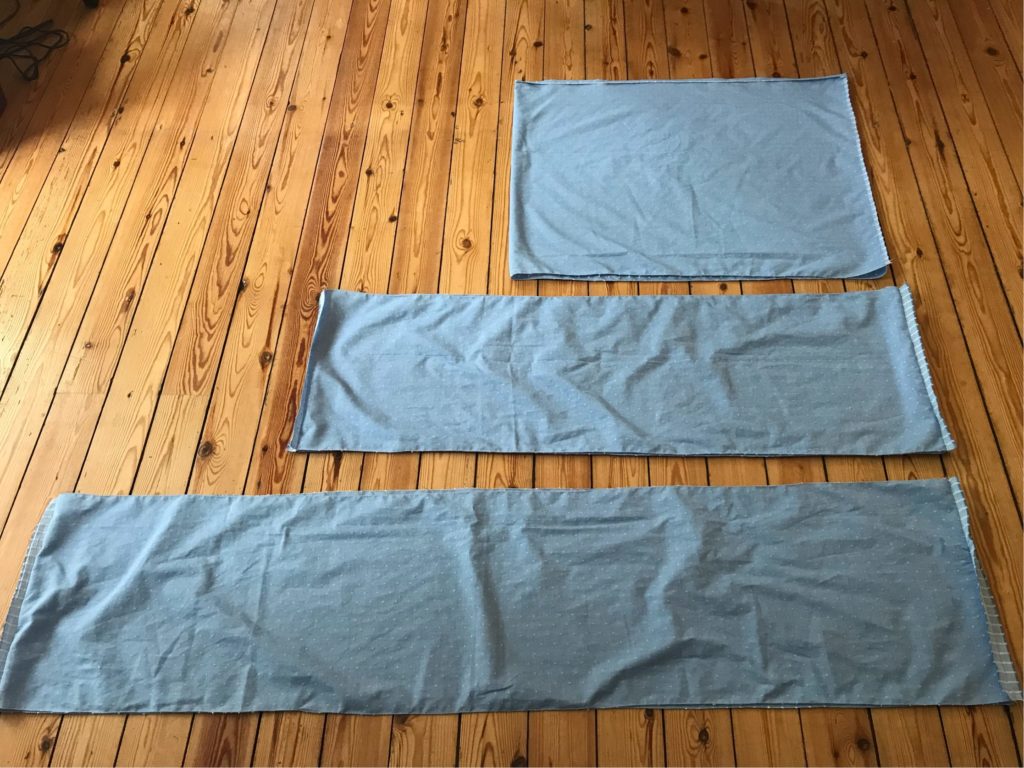
Make three tubes with the rectangles as follows:
- For the 150×56 rectangle, fold in two right side against right side of fabric, stitch the 56cm sides together, 1cm from the edge (1 seam).
- For the 110×32 rectangles, lay them on top of each other, right side against right side of fabric, stitch the 56cm sides together, 1cm from the edge (2 seams).
- For the 150×32 rectangles, lay them on top of each other, right side against right side of fabric, stitch the 56cm sides together, 1cm from the edge (2 seams).
- Open all seams with an iron.
You should end-up with this:
On the narrowest tube, prepare the elastic tunnel: on one of the large sides, turn the fabric 1.5cm inside , mark with an iron and stitch 1cm from the edge, leaving an opening of about 2cm of the back.
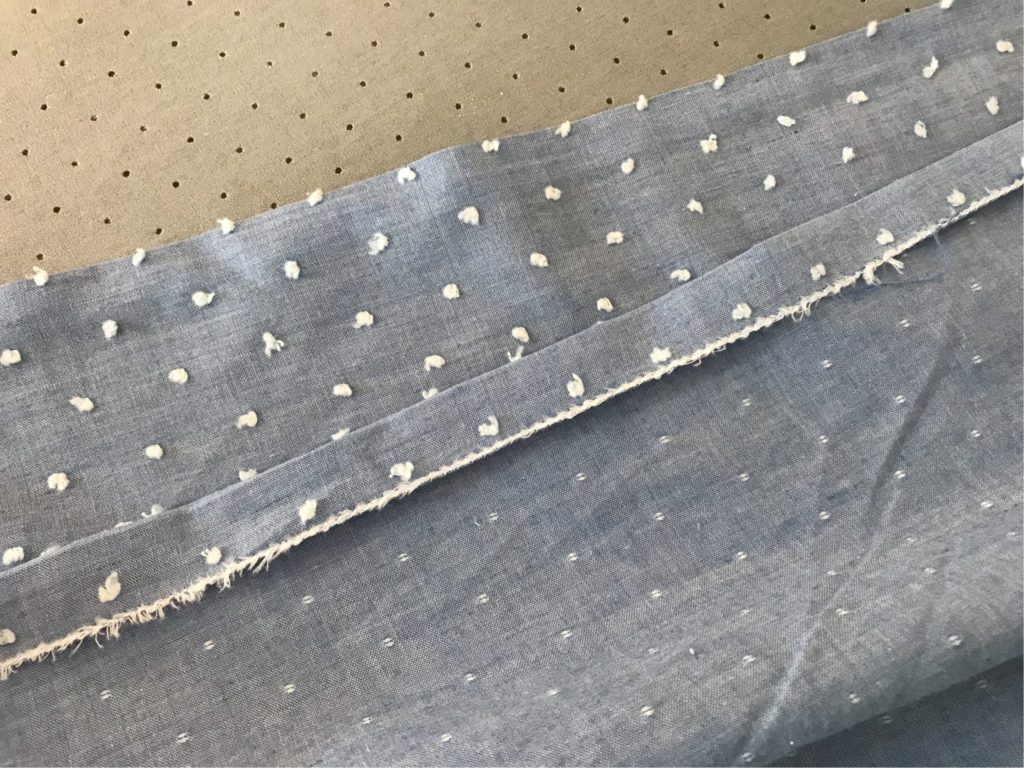
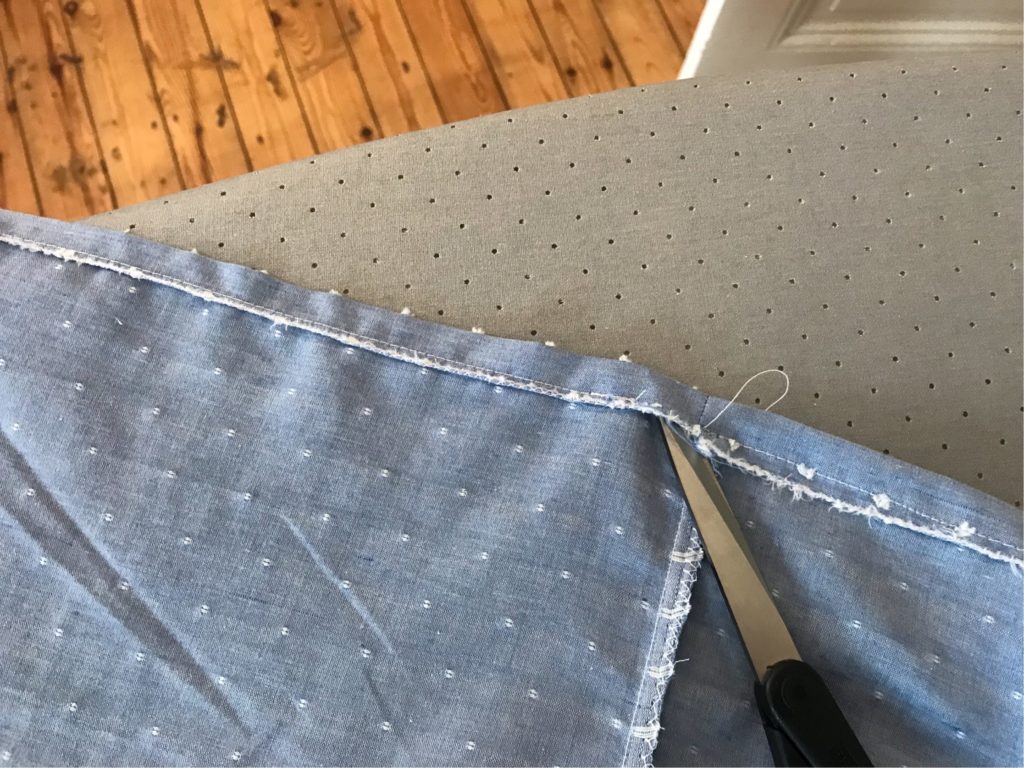
On the largest tube, make the hem: on one of the large sides, turn the fabric 1.5cm inside , mark with an iron and stitch 1cm from the edge, leaving no opening.
START SHIRRING
I already made a shirring tutorial for this dress, so the one here is extremely similar
First, get your sewing machine ready:
- Mount a spool of elastic thread by hand (without pulling excessively) and position it in your machine.
- The top yarn remains a classic yarn, with a color matching your fabric.
- Set your stitch width to the maximum (4/5), without touching the tension.
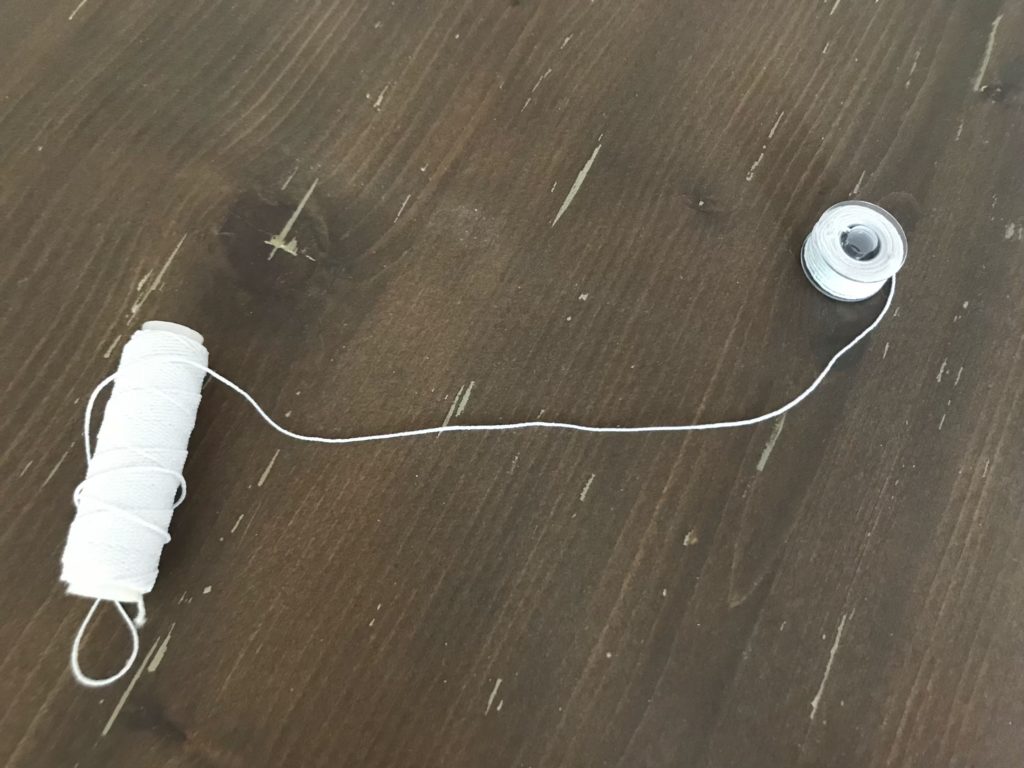
You can now start shirring:
- Place the fabric under the needle, right face of fabric facing you, elastic tunnel at the top. Place your needle 1cm below the previous seam
- Make a back-stitch at the beginning, then sew in a straight line all around the tube, finally make back-stitch the end – the elastic thread must be well blocked!
- Raise the needle and and place it 1cm below, and proceed again in the same way. A spool should cover between 5 and 8 rows. Block the thread well at each beginning and end of rank.
Your shirring should progress like this:
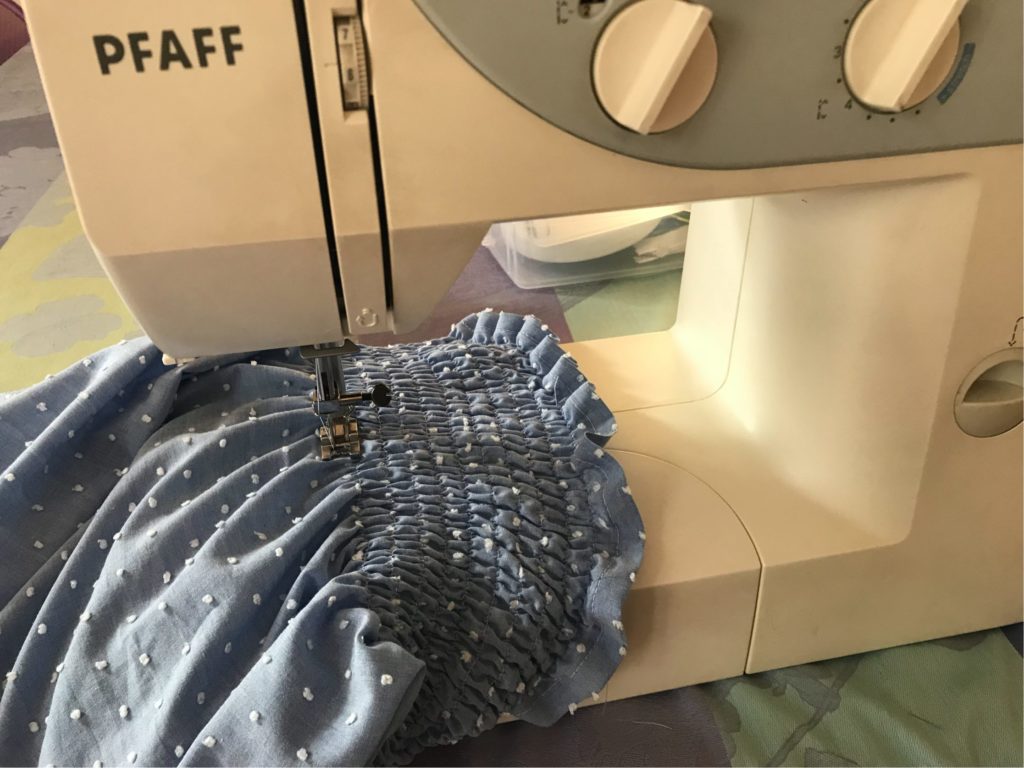
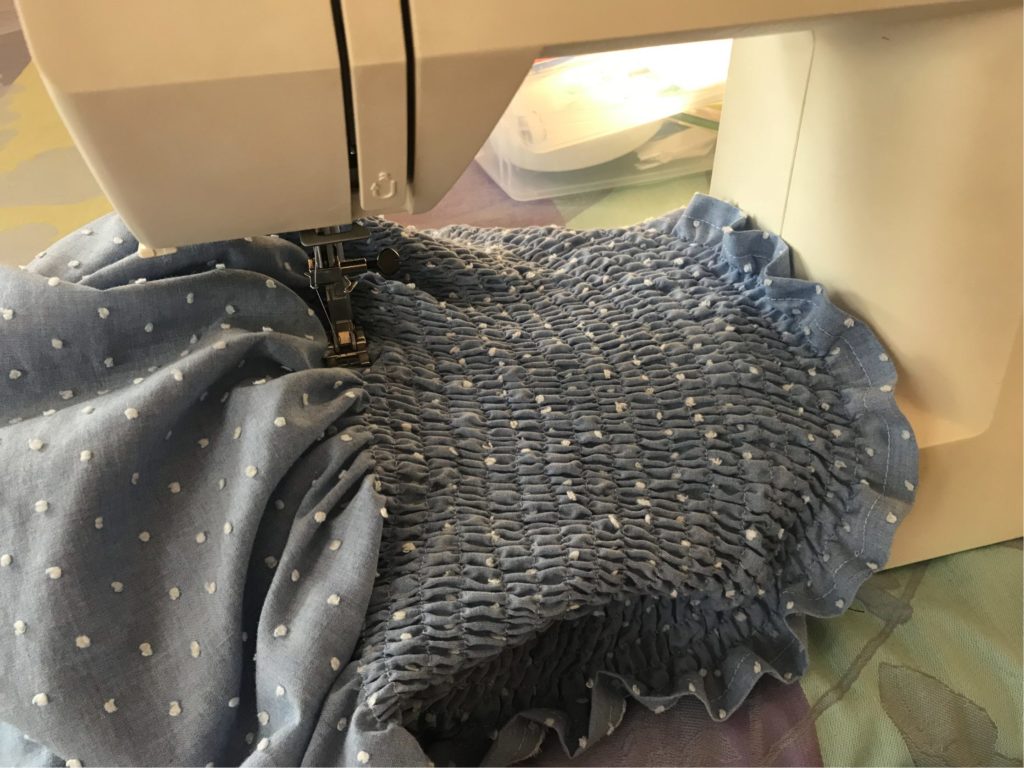
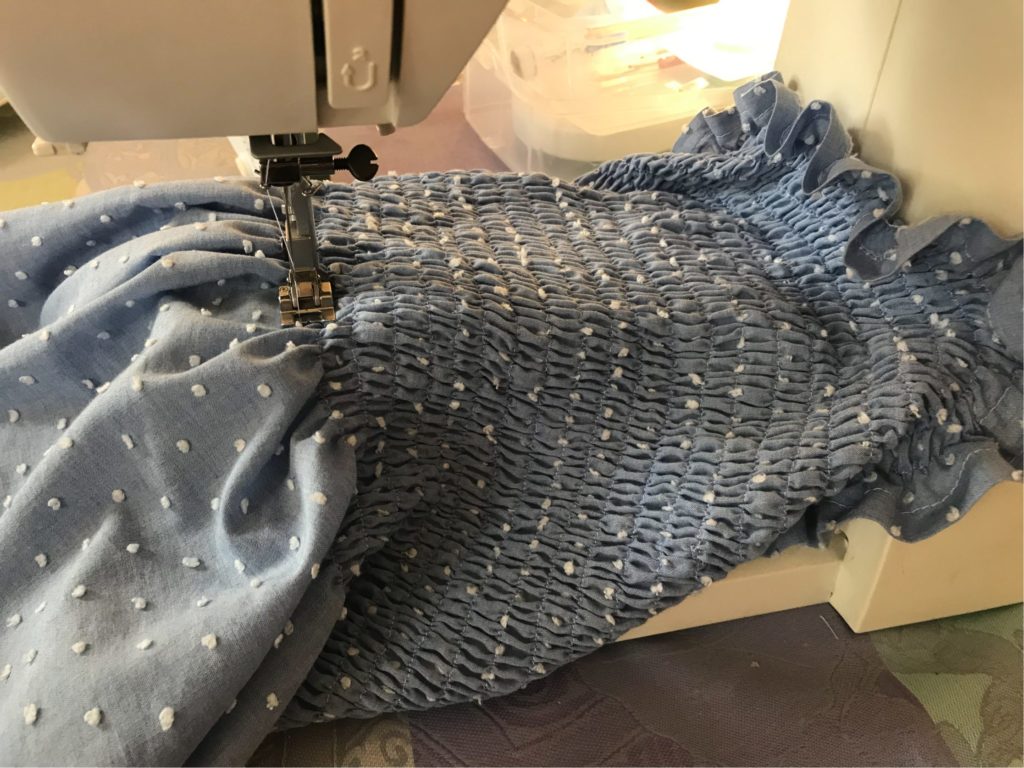
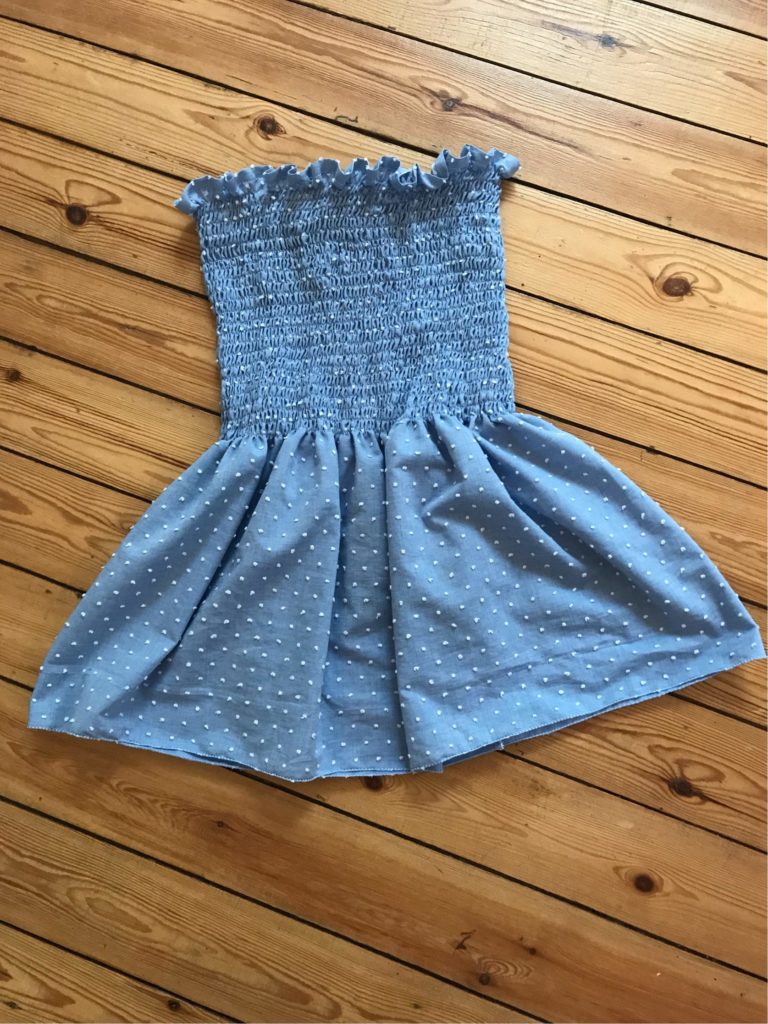
Try the dress on as you go to see where to stop shirring. I sew 28 rows (22cm), which allow the gathers to be well placed under the bust – but this will depend on your own measurements! Ideally you want the last line of shirring to reach the narrowest part of your torso, about 10 cm above your belly button.
Once you have finished shirring, here is what the top part of your dress should look like:
INSERTING THE RUFFLES
Change your bobbin thread: remove the elastic thread and put on the standard sewing thread.
To insert the first ruffle:
- Split the ruffle in 4 equal parts with pins; do the same for unshirred side of the top part of the dress.
- Insert gathering lines: set your machine on a large straight stitch (4/5) ans sew two parallel lines, one 0.5cm and the other 1.5cm away from the fabric hedge. Do not forget to leave enough thread at both beginning and end. To make the gathering easier and more regular, I divide my fabric in two (so four sewing lines in total, parallel 2 by 2).
- Assemble the ruffle and the top part of the dress together, matching the pins you’ve just laid. Pull on the threads to create gathers, until the width of the ruffle fabric matches that of the dress. Pin as you go along, being careful to keep your gathers regular.
- Put your sewing machine back to a normal-length stitch (around 2.5), put your fabric under the needle face up, and straight stitch 1cm from the fabric hedge.
- Check that you have caught all of the gathers and only then (calmly) get rid of your (meters of) gathering threads.
Here is the dress with one ruffle.
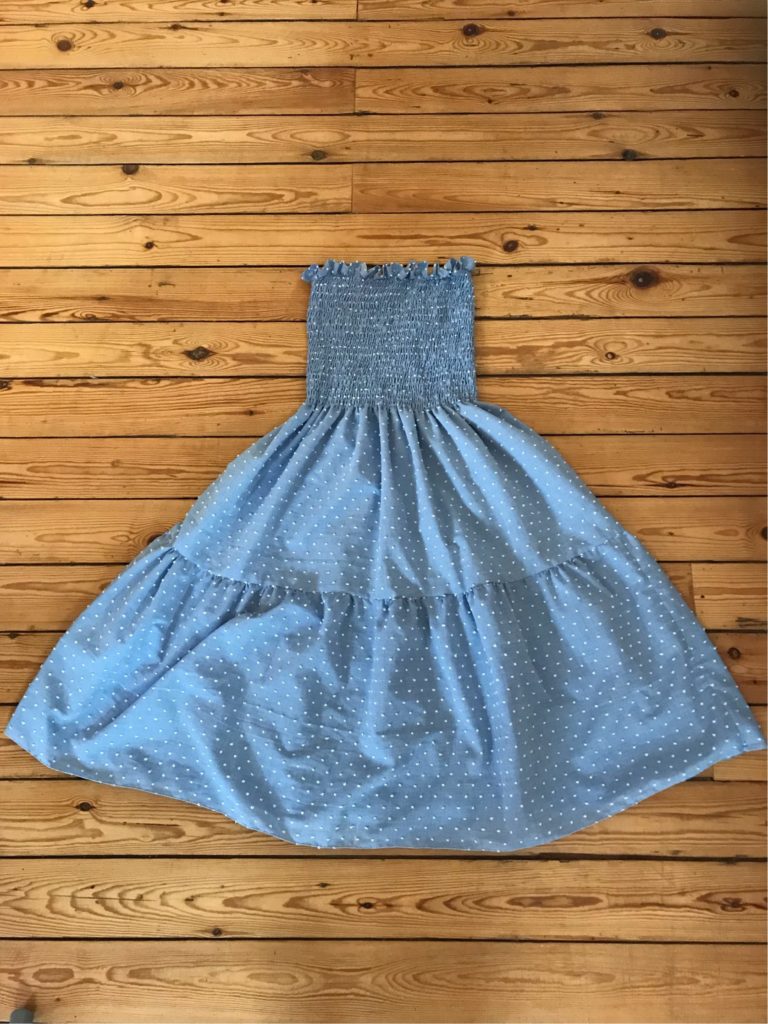
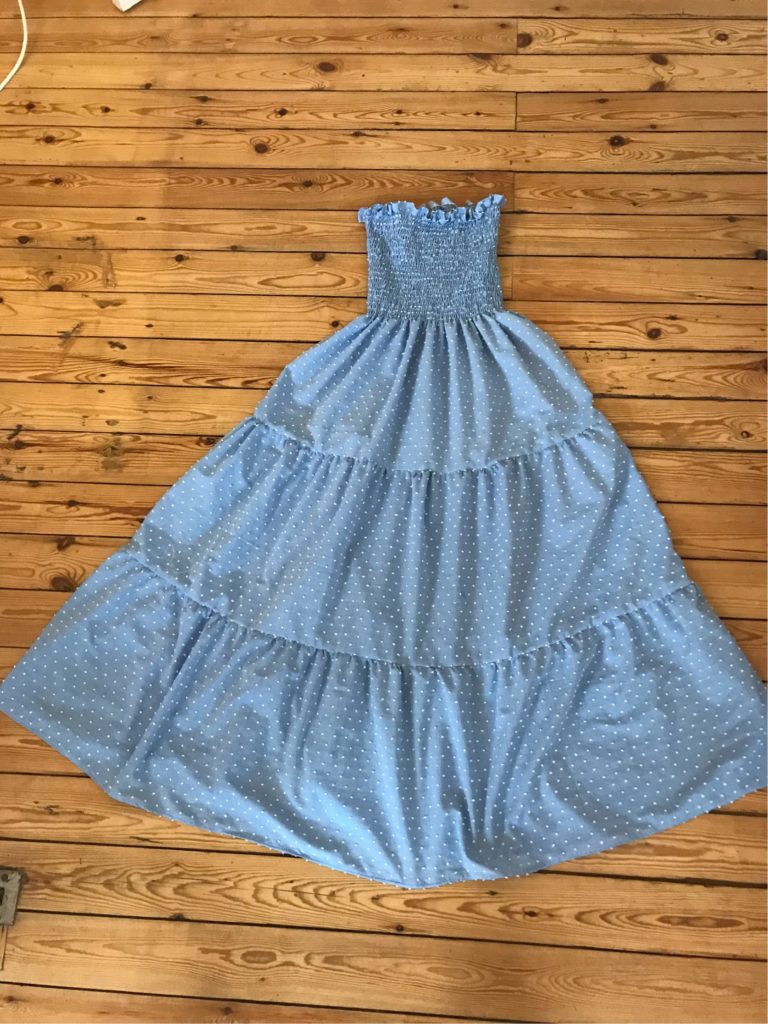
Proceed in the same way for the second ruffle, gathering the side of the largest rectangles which hasn’t been hemmed, and joining it to the first ruffle. Here is what things now look like!
INSERTING THE ELASTIC
On the previous photo, you can see that the fabric at the top of the dress is making some small folds, not very pretty, Let’s insert an elastic to solve this problem.
At the top of the dress, put the flat elastic in the tunnel you prepared at the beginning – you can use a safety pin, a skewer or any other tool that suits you. Put the dress on to determine the width cut the excess of elastic sew both side in a zigzag stitch. Make sure that the elastic does not turn in the tunnel before sewing.
Close the open section of the tunnel AND VOILA, your dress is ready!
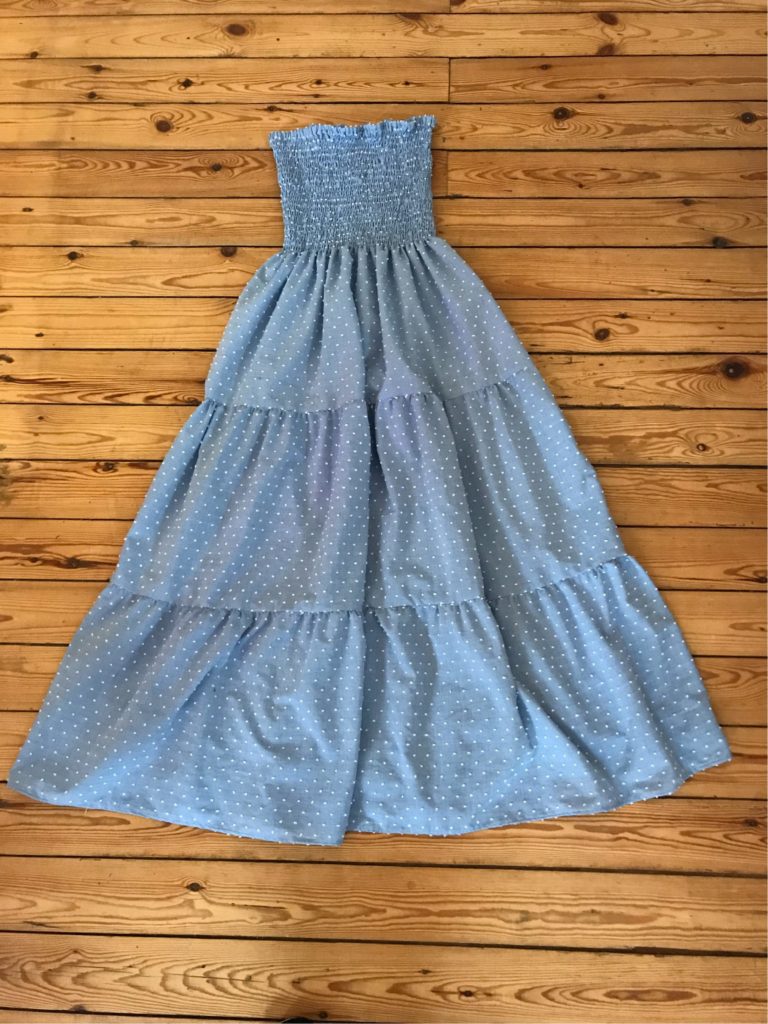
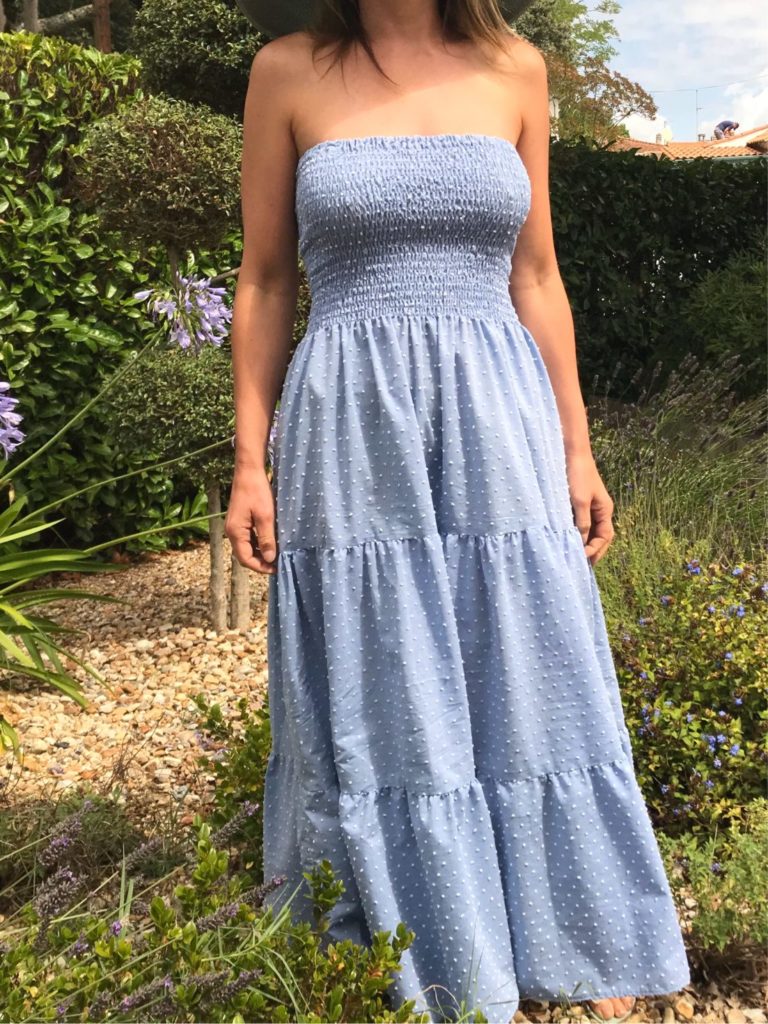
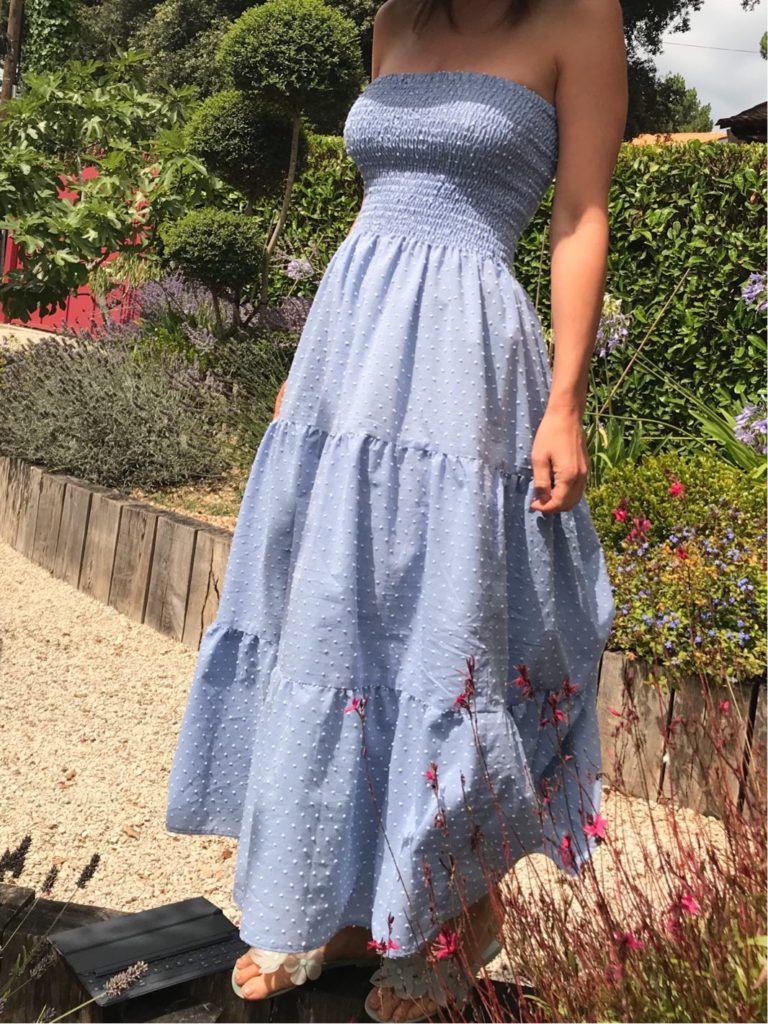
Even better worn! Fresh and nice for the summer!
THIS OTHER FREE TUTORIAL MIGHT BE OF INTEREST:
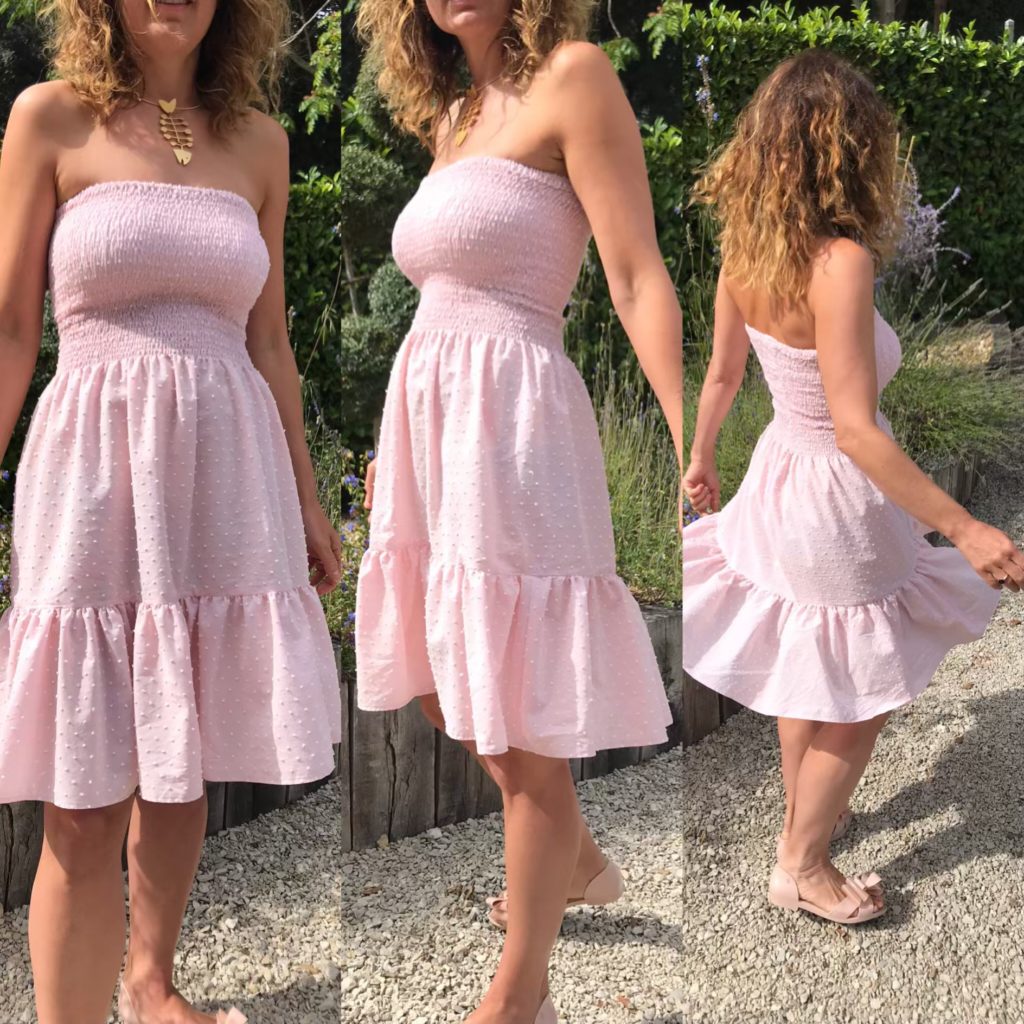
If you make a smocked dress with one of my tutorials, do not hesitate to use the hashtag #smocksmignons so that I can admire and re-gram it!!