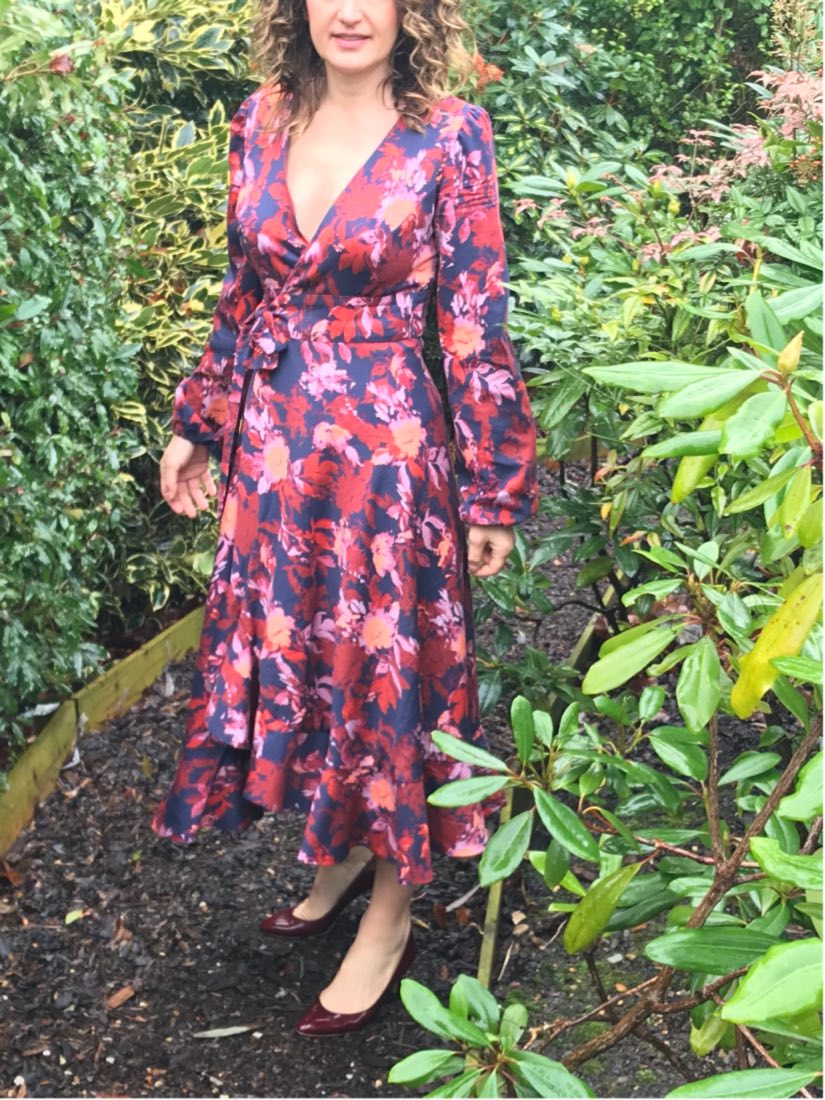
I’ve done it again! Another M7081 dress… in silk

I warned you a few months ago, McCalls’s M7081 has become one of me favourite ever patterns. And as I have turned into a complete fabric snob, I only sew silk now (only kidding – well…). So let me introduce you to my newest dress, a silk version of M7081.

M7981 pattern review: one of my favourites

This is my … well, seventh!!! version of this pattern… No wonder I can sew it with my eyes closed! I already reviewed it on the blog several times – see here and here for my winter versions; here and here for my summer versions.

So obviously I run the risk of repeating myself… but never enough of a good thing, right?

If you haven’t guessed already, I absolutely adore this pattern. It combines in a single dress all my favourite attributes: a mock wrap bodice, bust pleats, a fitted belt and a full circle skirt. The only possible improvement to the pattern would be to make the skirt midi length but then the fabric consumption would go completely out of control – one of my next articles will feature a maxi circle skirt (on its own) and I’ll give you more details.

I made my usual changes to the initial pattern. They consist in:

I cut a size 10 and added 1cm of extra ease at the waist as the fabric has no stretch whatsoever and was cut against the grain, but otherwise the fit is perfect.

Fabric used: more silk sewing

I am completely obsessed with sewing silk currently, as my recent articles testify – I have gathered all my advice on how to tackle this scary material in this article. Just to summarise the key points: pre-wash your fabric; work with a Microtex needle; avoid having to unsew stitches by using a tried-and-tested pattern; and work slow!

After having worked on lightweight silk crepe (here) and silk-wool mix (here), I went for heavier embroidered silk dupion. This one is from AmoThreads, it is still in stock and was a massive bargain for such a beauty. You can tell it is quite stiff from how the bodice pleats and the circle skirt fall.

Working with dupion is actually a dream: it is reasonably thick (comparable to a cotton poplin) and it does not slip under the sewing machine foot (unlike lightweight silk). I did not even have to use a Microtex needle here.

The only thing you need to be aware to avoid a heart attack is that silk dupion seems to massively shrink when wet … then it regains its size when dry. I had a huge fear after machine-washing my dress for the first time: the skirt lining became completely visible, while I had been careful to cut it way shorter than the silk skirt. Arrggghhh! But then all came back normal, pfiou…

Conclusion: another little jewel in my wardrobe

I am very pleased with this little dress and I have worn it a lot since sewn – hence the need to wash it. The colour is definitely more within my Autumn hues, so it feels a bit strange to wear it in February. When Spring arrives it will sadly go into my out-of-season closet so I am making the most of it now!

Sewing silk: my “nearly Dior” dress

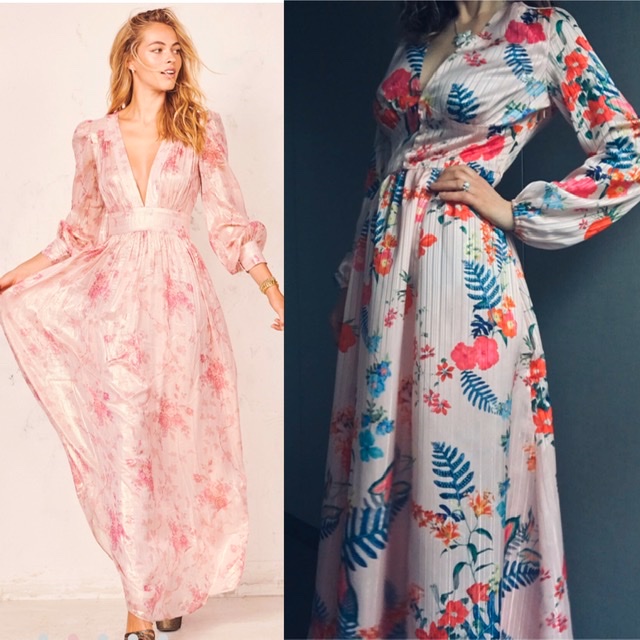
Do you have fabric stored in your stash, that you adore but is far too precious to touch? That’s exactly how I felt about this one: a silk-wool mix, with a modernised jungle toile de Jouy pattern, directly from Dior’s resort collection of a few years ago. Very expensive, very delicate… and very scary to work with!! Let me introduce you to my Dior silk dress:

THE fabric: Dior toile de Jouy

I was familiar with Dior’s toile de Jouy jungle theme thanks to my lovely husband, who surprised my with a gorgeous handbag a few years ago. Jouy en Josas, were toile de Jouy originated from, also holds a special place in our hearts as this is where we studied and started dating.

Toile de Jouy is characterised by pastoral scenes with a a few characters depicted in a natural background; and with the same motif repeated all over the fabric. Dior has reinterpreted it with jungle backgrounds, making it less traditional and a far more funky – my fabric is mostly palms and palm trees, with a few birds hardly visible.

Getting hold of such a beauty was no small matter. I had previously missed the exact same fabric in blue from Selvedge and Bolts (one of my favourite fabric shops) – matching my bag, arrrgghhh!!!. So when it came back in a colour which is definitely not within my usuals, I did not think and immediately ordered 3 meters! – from my phone on the street… My Bestie was there and can testify… Fabric addiction is that bad!

Sewing with silk… again!

And then it stayed in my stash until I felt confident enough to sew it! That actually only happened a few weeks ago, when my first big silk project – otherwise named the coral bubble dress – turned out as a success.

I wrote a full article with advice and tips on how to sew silk here, so do have a read for more details. I did pretty much followed my own advice:

Pattern review and modifications: V9327

You may have recognised V9327, a winter dress pattern which I had already used twice and reviewed once in the blog. Both previous versions were in wool suiting, a material way easier to use than this one! I made the black version two winters ago and I do wear it a lot.

I really like this pattern for:

I made no changes other than fully lining it – with silk of course. Here is what the dress looks like from this inside:

For this purpose, I made a second exact same dress in white silk and joined it to the first dress at the collar before adding my back invisible zip; and then added the zip as if both dresses were one.

This time I also covered the back sewing margins with bias tape, which I usually don’t do but why not waste even more time for unnecessary details… To be fair, I was worried the wool sewing margins would turn out to be itchy next to the skin… so not completely unnecessary!

Conclusion

Will you believe it: I actually did not like this dress the first time we took pictures! We had chosen a dark background and I really felt like I had sewn a camouflage suit!

Obviously since then my view has completely changed. This dress is so lightweight and soft it is wonderful to wear it. And although it is not in my usual colour palette, I’m definitely starting to really fancy the warm hues – especially since I bought new boots to match (not shown here), naughty girl!

And if you’ve read to the end of this article, here is my little secret: I have managed to source two other Dior fabrics (silk only this time) and can’t wait to get started on them. Do you have any suggestions of long, fitted but floaty dress pattern I could use?

Free knitting pattern: the Floating Leaves Beanie

That’s it, I have crossed the dangerous line between making and designing… Let me introduce you the Floating Leaves Beanie, a quick and easy knit, with beautiful lace details and … a free pattern!

Technical details

This beanie is knitted is 4mm/ US 6 needles, with a gauge of 22 stitches for 10cm width (or thereabout, no need to be super precise). Here I have used my beloved combination of Drops Baby Merino and Drops Kids Silk, but you can pretty much use anything as long as there is a bit of elasticity (I would definitely not recommend using solely kid silk for instance.)

The joy about knitting a beanie is that it takes very little time (about 3 hours ). And you can use leftover yarn! The burgundy version is from leftovers of my Icon dress (colour codes 34 for the baby merino and 17 for the kid silk).

… while the blue version if from leftover of my daughters’ Blossom jumper (colour codes 11 for the baby merino and 07 for the kid silk).

Do not hesitate to browse my other knitting projects for more baby merino/ kid silk colour combinations, as these have been my yarns of choice over the past year so I have experimented a lot: green, purple, yellow, powder pink, coral, black, off white

Knitting lace

This project obviously implies knitting lace, but that should really not scare you as there are very few stitches to know and they are in no way exotic– and in any case they are all explained on this website (my favourite), with videos of both the continental and the English knitting styles.

In the pattern, I have included the lace instructions both in diagrams and written, so that you choose whichever suits you best.

If you’ve never tried, I really recommend you give lace a go, as it give such an amazing outcome for not a huge effort. Also a beanie knits fully in the round, making things even easier

Matching you beanie

I am a huge fan of knitted lace leaves and the Floating Leaves Beanie was strongly inspired by Maria Magnusson’s Leaving Cowl, a free pattern on Ravelry. They therefore match exquisitely.

I also knitted a Floating Leaves scarf, but to be honest I found it quite a boring project… I am definitely not a scarves fan!

Another matching candidate is Betsy App’s Suspended Leaves shawl (also a free Ravelry pattern). This is a project I have already knitted twice and which I adore.

And my dream is to design a cropped, fitted Floating Leaves jumper but I have little hope of achieving this any time soon… The fitted aspect with all-over lace is always tricky. Anyway!

Free pattern

And here is the free pattern, available both in English and in French. I am a complete amateur pattern writer and this is my first ever pattern, so please feel free to let me know if there are mistakes (despite my many many checks). If you make this beanie let me know and let’s reference it as #floatingleavesbeanie!

Floating-Leaves-Beanie-Instructions-ENG-PDFTélécharger

Three Elegante skirts for the winter

My ever-growing collection of hand-knitted cardigans has been calling for matching skirts since the beginning of the winter. What better excuse to make a few Elegante skirts, a pattern by Popeline Linon I had been eying for a while. So here is version 1, in an embroidered denim fabric from Selvedge and Bolts:

version 2 in a candy pink and baby blue brocard, also from Selvedge and Bolts:

… and version three, in an off-white and black checked wool from Croftmill:

L’Elegante by Popeline Linon: pattern review

L’Elegante is a midi (on the longer midi side actually) skirt, pleated at the waist with box-pleats and with a very pretty shaped waist. It comes with a large belt, which in my view is absolutely necessary to make – without it, the skirt loses a lot of its appeal.

The pleats are well-proportioned and well-positioned – not funny effect at the back, I assure you!

The pattern was issued a while ago and was a success among French Instagram seamstresses – now I know why! It is quite straightforward to make, very comfortable to wear and consumes a relatively modest amount of fabric for a big skirt (2.3m in my case).

I cut a size 36, which corresponded exactly to my waist measurements, and the fit is perfect – the waist measurement is crucial but the hip measurement is pretty irrelevant, as the skirt is not fitted. I am 1m68 and the skirt is quite long for a midi skirt and could easily be shortened – I personally like it this way.

The instructions are very clear (although I am not sure using a busy floral fabric for the pictures was the best idea) and the only change I made to te pattern was lining the skirt (I’m sure you could have guessed that!!). I basically cut a rectangle of fabric of 150x70cm, gathered the top to the belt width and sandwiched it into the belt.

Fabrics used

I used very different-looking fabrics and I am very pleased with each of them. The one thing they have in common is that they are reasonably heavy and structured (but not overly so), which I think works well with the box-pleats.

Fabric one is an embroidered denim from Selvedge and Bolts. The denim is quite light in itself but the amount of embroidery makes it much stiffer and heavier. I really like the fact that there are some blue threads in the embroidery, allowing me to mix and match with my blue Belladonna cardigans (number 2 here).

Fabric 2 is a light brocart, from Selvedge and Bolts too. I absolutely adore the colours – I am a candy girl at heart – and I think I will be able to transition this skirt easily into Spring. Here too a perfect match with Belladonna, version 1 this time.

Fabric 3 is a slightly stretchy checked wool from Croftmill – the stretch was definitely not necessary but never mind. As ever for Croftmill’s wools, the quality is to die for – if I was not worried about pattern matching (definitely not a success here), I would definitely buy more to make a fitted dress. This one will be worn with my off-white Agatha and my black Belladonna cardigans.

Conclusion

I must admit that I was hugely tempted to make dresses out of these fabrics – I always am – but I am very pleased I didn’t. This winter has been quite cold by London standards and skirts are so much easier to wear than dresses when it’s colder (especially with thermal turtlenecks!). They also perfectly work with my hand-knitted cardigans – and I definitely needed a justification to continue knitting more. A never-ending virtuous circle of garment making!